Home Real Estate Strategy Tourism Development National Vision Strategy Special Projects Digital Transformation Experience Reports Insights About Us Services Contact
Englishالعربية中文日本語EspañolFrançaisItalianoPortuguêsΕλληνικάDeutschSuomiDanskRomânăKiswahiliРусскийКыргызчаҚазақшаTürkçe

Heirstone Consulting Research · The Africa Series · October 2026

Agro-Industrial Zones in North and Sub-Saharan Africa: The crop comes first

Agro-industrial parks and agropoles: what they have delivered, and where processing in Africa actually happens. A register of 20 zones in 12 countries, from Morocco and Egypt to Nigeria, Senegal, Côte d'Ivoire, Benin and Ethiopia.

28 pages · PDF · English and French · Free

Also available in French: Zones agro-industrielles en Afrique du Nord et en Afrique subsaharienne: La récolte d’abord. Choose the language when you request the report.
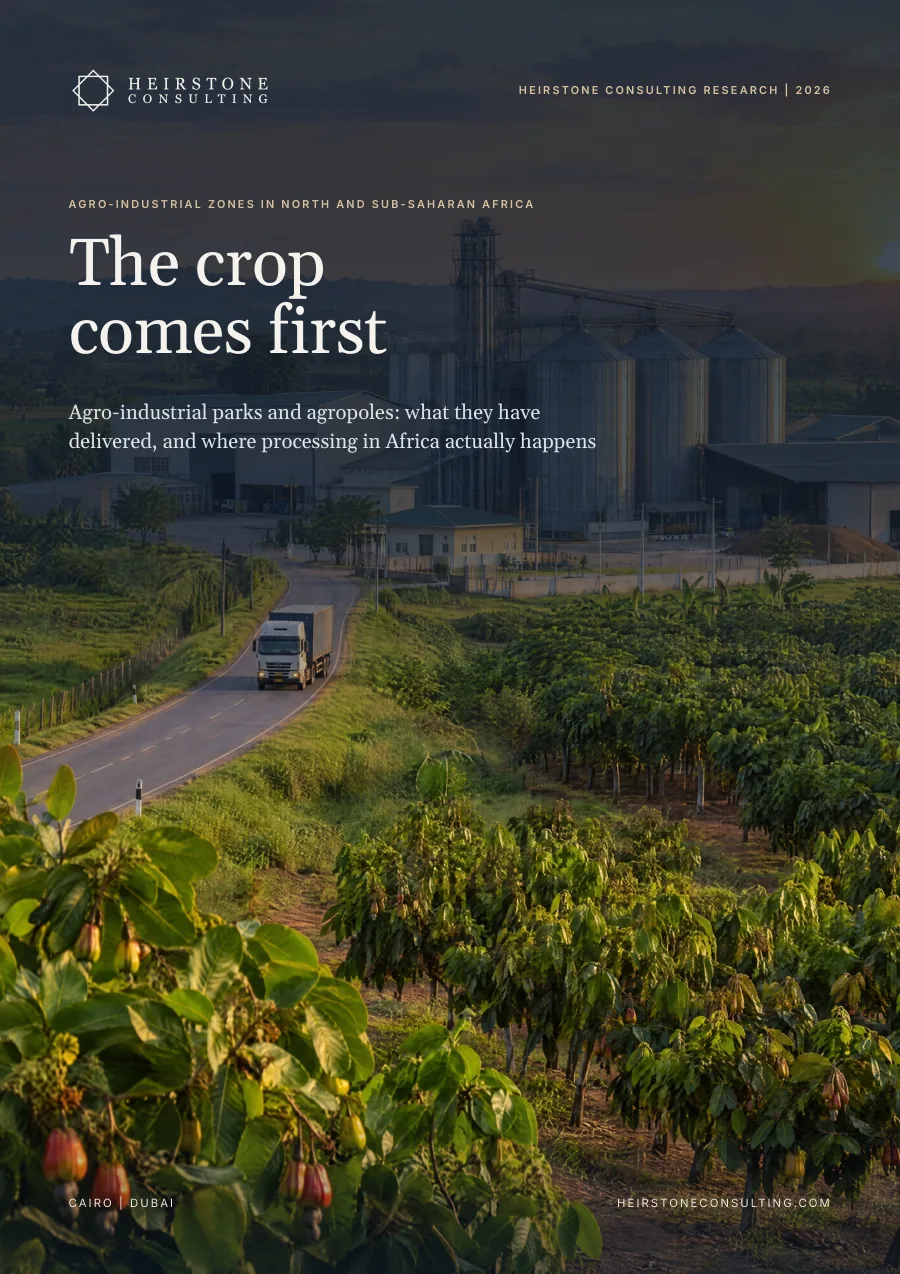
Cover of the Heirstone Consulting Research report Agro-Industrial Zones in North and Sub-Saharan Africa: The crop comes first

The report in six numbers

700

direct jobs at Ethiopia's Yirgalem park by late 2024, against more than 100,000 expected at its opening in 2021

55 on 55

companies on saleable hectares at Morocco's Souss Massa agropole, which is 90% commercialised

43%

of Côte d'Ivoire's record 2025 cashew crop processed at home, up from 21% in 2023

−58%

fall in Benin's cashew export earnings in 2024, the year its raw-nut export ban took effect

US$934m

committed by the AfDB to special agro-industrial processing zones: 27 sites in 11 countries (April 2025)

6%

of the 80,000 hectares allocated to the DRC's Bukanga-Lonzo park was planted at the 2014 peak, according to the Oakland Institute

In brief

Processing has followed the crop and the policy. Most purpose-built zones are still waiting for both.

We built a register of 20 agro-industrial zones and programmes in 12 countries and set it against the trade record for cocoa, cashew, coffee, tea and oils. The zones that filled were small and phased, and sat close to a crop already moving in volume. The largest processing gains, in Côte d'Ivoire's cocoa grinding and cashew shelling, came from crop volume and policy, not from a flagship zone.

  1. Job targets run far ahead of any processing workforce we can measure.

    Seven programmes in the register promise 22,000 to 400,000 jobs each, while Côte d'Ivoire's cashew-processing industry, Africa's largest, employed about 15,000 people in 2024. Ethiopia's Yirgalem park was expected to create over 100,000 direct jobs when it opened in 2021 and had just over 700 by late 2024.

  2. Working agropoles sell about one hectare per firm.

    Morocco's Souss Massa agropole has 55 companies on 55 saleable hectares and is 90% sold. Ethiopia's four pilot parks cover 680 to 980 hectares and had 18 operating investors in 2024. A 15,000-tonne cashew plant in Benin occupies 1.7 hectares.

  3. One label covers two different businesses.

    Processing parks cost US$0.2m to US$1.1m per hectare, while territorial agropoles spread US$10,000 to US$90,000 per hectare over farmland, irrigation and roads. The AfDB has committed over US$934m to 27 sites in 11 countries, and outcomes by site are rarely published.

  4. Côte d'Ivoire built its processing industry largely outside agro-zones.

    It has out-ground the Netherlands in cocoa since 2020/21, and local cashew processing rose from 21% of the crop in 2023 to 43% in 2025 alongside export taxes, floor prices and nut allocation. Its pilot agropole hosts one cashew plant.

  5. Benin's export ban has yet to fill its factories.

    The raw-cashew export ban took effect in April 2024, and recorded cashew export earnings fell 58% that year. Local processing reached about 50,000 t in 2025, and the consultant Jim Fitzpatrick, quoted by Benin Web TV, estimates that nearly 70% of the 2024/25 crop went to Togo or Nigeria.

  6. At the one park with plant-level data, supply was the binding constraint.

    At Yirgalem in 2024 the avocado-oil plant ran at about 70% of capacity, another processor at 35% to 40%, and a dairy's milk intake had fallen to 300 litres a day from 2,000. Sub-Saharan Africa lost 23.0% of its food between harvest and retail in 2023, up from 22.1% in 2015 (FAO).

What it means

Recommendations by audience

Governments and investment promotion agencies

Size zones to a proven crop, release land in 20 to 50 hectare tranches, and publish operating tenants, tonnes processed and jobs every year.

Development finance institutions

Release park money against tenants and tonnes processed, and appraise farmland programmes separately from processing parks.

Agribusiness and food processors

Locate where the crop and the price edge are, and secure raw material and seasonal working capital before floor space.

Zone developers and investors

Underwrite operating tenants per serviced hectare, and price the policy that sends the crop to the zone.

Inside the full report

28 pages of evidence, benchmarks and tests

  1. Promises and payrolls
  2. Twenty zones, five models
  3. Where the processing went
  4. Pushing the crop into the factory
  5. Feedstock before floor space
  6. North Africa and Sub-Saharan Africa
  7. The Heirstone Agro-Zone Test

Heirstone datasets

20

zones and programmes in the Heirstone Agro-Zone Register, across 12 countries

10

export lines in the Heirstone Value-Capture Table, comparing raw and processed prices from cashew to cotton

6

gates in the Heirstone Agro-Zone Test, applied to seven programmes under way or planned

Built from public sources current at October 2026. Every figure is referenced in the report, and figures we derive by combining published numbers are labelled Heirstone analysis.

Frequently asked questions

Do agro-industrial parks in Africa create jobs?

Far fewer than announced so far. Ethiopia's Yirgalem park was expected to create over 100,000 direct jobs and had about 700 by late 2024. Seven programmes in Heirstone's register promise 22,000 to 400,000 jobs each, against about 15,000 people in Côte d'Ivoire's entire cashew-processing industry.

What is Nigeria's Special Agro-Industrial Processing Zones programme?

It is an AfDB-backed programme of agro-industrial hubs approved in December 2021, with phase 1 covering seven states and the federal capital territory. The AfDB put phase 1 at US$510m in April 2025, when ground was broken in Kaduna and Cross River, and it targets 400,000 direct jobs.

Did Benin's raw cashew export ban work?

Not yet on the early figures. Benin's recorded cashew export earnings fell 58% in 2024, the ban's first year, and a consultant estimates that nearly 70% of the 2024/25 crop went to Togo or Nigeria. Local processing did rise, from 13,000 t in 2020 to about 50,000 t in 2025.

National Vision

How we can help

Explore the practice

Heirstone Consulting Research

More from The Africa Series

All reports

Discuss Your Mandate

Speak directly with a senior partner about your project, asset or programme.

Get in Touch

Heirstone Consulting Research

Get the full report

Enter your details and we will email you a personal download link. Please use an address you can open: the report is sent only to that inbox.