Home Real Estate Strategy Tourism Development National Vision Strategy Special Projects Digital Transformation Experience Reports Insights About Us Services Contact
Englishالعربية中文日本語EspañolFrançaisItalianoPortuguêsΕλληνικάDeutschSuomiDanskRomânăKiswahiliРусскийКыргызчаҚазақшаTürkçe

Heirstone Consulting Research · The Africa Series · October 2026

Air Access and Tourism in Africa: Empty seats, full terminals

Seats, routes, fares, taxes, visas and open skies: what really limits tourist arrivals in North and Sub-Saharan Africa, from Marrakech and the Red Sea to Cape Town and Zanzibar, and what governments, airports and investors can change.

28 pages · PDF · English and French · Free

Also available in French: Desserte aérienne et tourisme en Afrique: Sièges vides, terminaux pleins. Choose the language when you request the report.
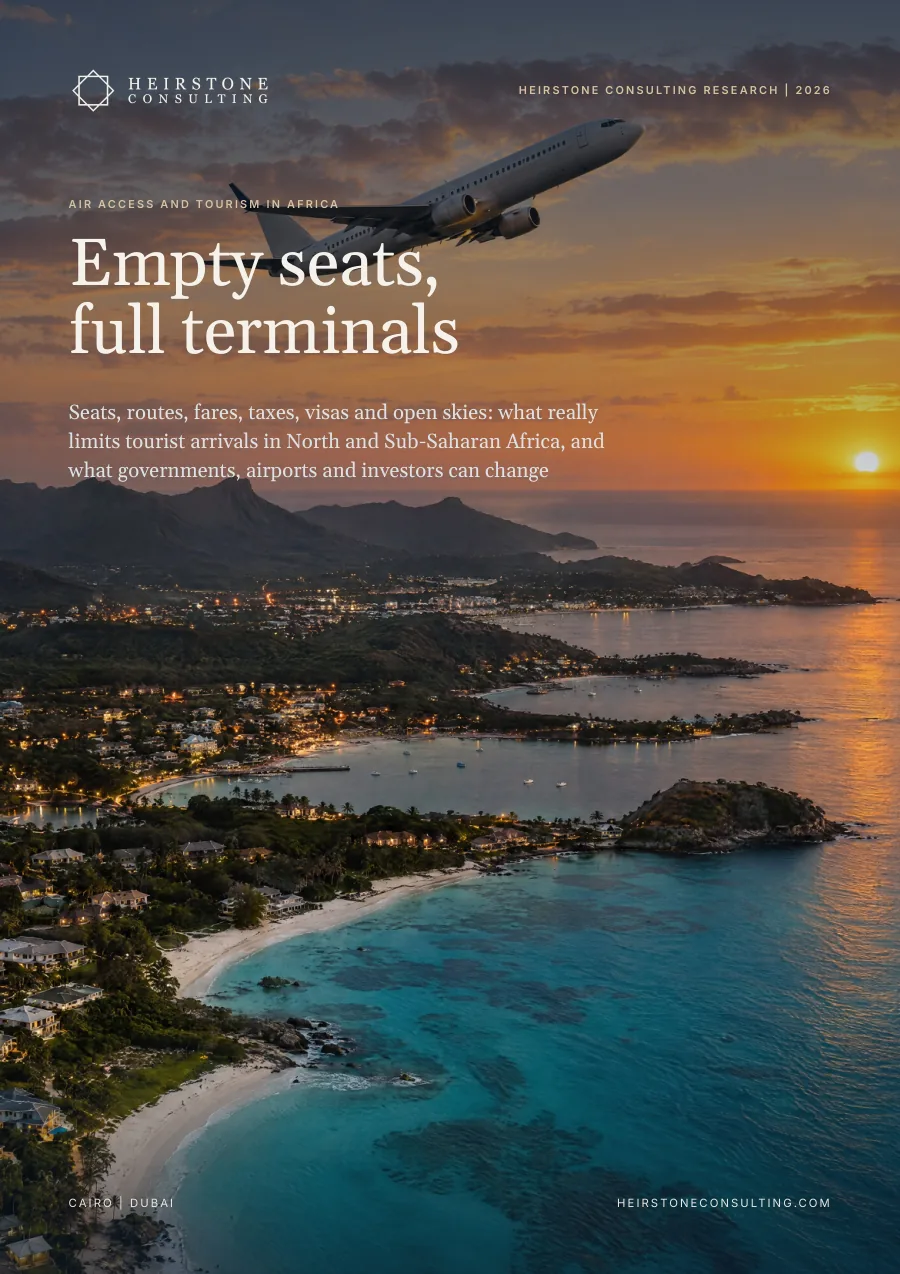
Cover of the Heirstone Consulting Research report Air Access and Tourism in Africa: Empty seats, full terminals

The report in six numbers

32.3%

passenger growth at Sharm el-Sheikh in 2025, the fastest of Africa's 26 largest airports

75.3%

Africa's 2025 passenger load factor, the lowest of any world region (world: 83.6%)

113%

Marrakech airport traffic in 2025 as a share of the design capacity of its terminals

US$68

average taxes and charges on an international departure from Africa in 2024, against US$34 in the Middle East and US$30 in Europe

8 of 38

signatories of the Single African Air Transport Market that had put its concrete measures in place by 2025

+80%

growth in Cape Town's international passengers over ten years of its route-development programme

In brief

One seat in four flew empty in Africa in 2025, yet the busiest leisure gateways ran full.

Most debate on African air access asks for more flights and stronger national airlines. We looked at seats, terminals, taxes, visas and traffic rights across North and Sub-Saharan Africa, including 18 dated cases from twelve countries. Seats are plentiful on average and scarce at a handful of leisure gateways, and governments set much of their price through taxes, visas and traffic rights.

  1. Foreign airlines hold just over half of Africa's international seats.

    Africa took about 5.3% of the world's international tourist arrivals in 2025, while its airlines flew 2.2% of world passenger kilometres. Non-African carriers held 52.8% of Africa's international seats in August 2026, according to AFRAA.

  2. On average, seats are plentiful.

    Africa's 2025 load factor of 75.3% was the lowest of any region, according to IATA. In each 2026 period we could source, capacity grew faster than traffic: 6.8% against 4.1% in the first quarter, and 8.3% against 6.7% in August.

  3. The squeeze is at a few leisure gateways.

    Marrakech's traffic reached 113% of its terminals' design capacity in 2025, and Zanzibar's 1.8 times that of its international terminal. Nine leisure gateways, led by Sharm el-Sheikh at 32.3%, grew 15.4% in 2025, about twice the hubs' rate.

  4. Governments set much of the fare.

    International departure charges run from US$15 to 29 in Tunisia, Morocco and South Africa to US$112 to 180 in Ghana, Senegal and Nigeria. AFRAA puts taxes and charges at 35 to 40% of African ticket prices, and the 2024 average departure charge, US$68, was 52 times African airlines' 2025 net profit per passenger.

  5. Open skies are signed more often than practised.

    Thirty-eight states have signed the Single African Air Transport Market commitment, and AFRAA counts eight that had applied its measures by 2025. The share of intra-African travel scenarios needing a visa before travel rose to 51.1% in 2025, and US$857m of airline revenue was blocked in seven African jurisdictions in October 2025.

  6. Bought seats have outperformed owned airlines.

    Egypt paid tour operators US$30 a seat in 2016 and reached a record of about 19m arrivals in 2025. Cape Town's route-development partnership added 33 international routes in ten years. Morocco's arrivals rose from 12.9m to 19.8m between 2019 and 2025, and Tunisia's grew while Tunisair lost a third of its passengers.

What it means

Recommendations by audience

Tourism authorities

Fund route development and report arrivals per inbound seat at each gateway, rather than the national airline's size.

Finance ministries and immigration

Price departures against the US$30 to 34 charged in Europe and the Middle East, stop taxing transfer passengers, and replace visas for main markets with low-cost electronic authorisations.

Airports

Add terminal space first where leisure traffic already exceeds design, as at Marrakech and Zanzibar, and report seats as well as passengers each month.

Developers and hotel investors

Test seats, price, entry rules and terminal headroom before buying land, and treat a new airport's published opening date as a best case.

Inside the full report

28 pages of evidence, benchmarks and tests

  1. Flown by others
  2. The pinch points
  3. What moved arrivals
  4. Tariffs on arrivals
  5. The Heirstone Air Access Scorecard
  6. North Africa and Sub-Saharan Africa
  7. What to do

Heirstone datasets

18

dated cases in the Heirstone Air Access Case Book, from twelve countries

20

countries rated on five levers in the Heirstone Air Access Scorecard: price, visas, low-cost base, hub reach and gateway load

5

questions in Heirstone's access-before-assets test for resort and hotel projects

Built from public sources current at October 2026. Every figure is referenced in the report, and figures we derive by combining published numbers are labelled Heirstone analysis.

Frequently asked questions

Why are flights to and within Africa so expensive?

Taxes and charges are a large part of it. AFRAA puts them at 35 to 40% of African ticket prices against about 20% globally, and the average international departure charge from Africa was US$68 in 2024, twice the Middle East's US$34. Nigeria charges US$180 and Gabon US$298.

Which African airports are over capacity?

Marrakech and Zanzibar. Marrakech handled 10.2 million passengers in 2025 through terminals designed for 9 million, 113% of capacity, and Zanzibar's airport traffic was 1.8 times the design capacity of its international terminal. Hurghada's new terminal, designed for 13 million, was 88% full.

Does a national airline increase tourist arrivals?

Rarely, on the cases Heirstone reviewed. Tunisia's arrivals grew while Tunisair lost a third of its passengers, and Kenya's visitors rose 37.5% between 2013 and 2019, about twice the growth in Kenya Airways passengers. Egypt and Cape Town grew arrivals through seat incentives and route development with other airlines.

Tourism Development

How we can help

Explore the practice

Heirstone Consulting Research

More from The Africa Series

All reports

Discuss Your Mandate

Speak directly with a senior partner about your project, asset or programme.

Get in Touch

Heirstone Consulting Research

Get the full report

Enter your details and we will email you a personal download link. Please use an address you can open: the report is sent only to that inbox.