Home Real Estate Strategy Tourism Development National Vision Strategy Special Projects Digital Transformation Experience Reports Insights About Us Services Contact
Englishالعربية中文日本語EspañolFrançaisItalianoPortuguêsΕλληνικάDeutschSuomiDanskRomânăKiswahiliРусскийКыргызчаҚазақшаTürkçe

Heirstone Consulting Research · The Africa Series · October 2026

Conservation Tourism in Africa: The bed and the hectare

What high-value, low-volume tourism earns per bed and per hectare in Kenya, Rwanda, Botswana, Tanzania and Namibia, who is paid for the land, and what it would take to make the model work in North Africa.

29 pages · PDF · English and French · Free

Also available in French: Tourisme de conservation en Afrique: Le lit et l’hectare. Choose the language when you request the report.
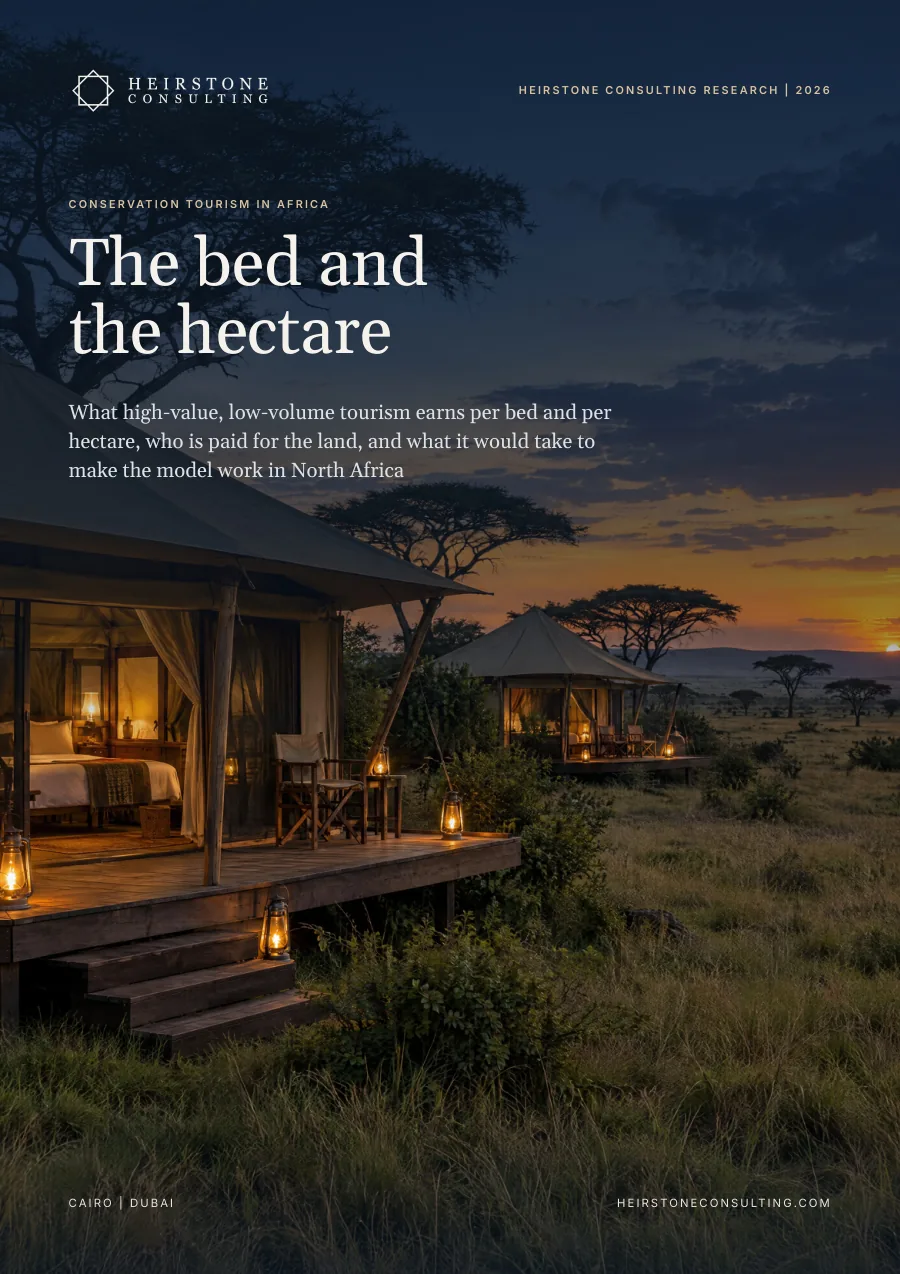
Cover of the Heirstone Consulting Research report Conservation Tourism in Africa: The bed and the hectare

The report in six numbers

6.2-6.7

beds per 1,000 ha in the Olare Motorogi and Naboisho conservancies of the Maasai Mara, six times the Okavango Delta's 1.05 (Heirstone analysis)

US$389

tourism receipts per international arrival in Rwanda in 2019, against US$1,094 in Egypt (Heirstone analysis of World Bank data)

US$41

per hectare a year paid to Olare Orok landowners in 2011, up from US$33 when the conservancy opened in 2006

US$130

conservancy fee per guest-night in 2026 in Mara North, Olare Motorogi and Naboisho, collected through camp rates

US$2,238

revenue per hectare at Volcanoes National Park, Rwanda, in 2025: US$35.8m from about 16,000 ha (Heirstone analysis)

3 million

nature-reserve visitors a year in Egypt's protected areas, more than 20 times the visitors to Rwanda's national parks in 2024 (UNDP BIOFIN, Heirstone analysis)

In brief

High-value, low-volume tourism earns less per arrival than Egypt's volume model, and far more per hectare than any other conservation income we measured.

The model pays when it is measured by land. Three numbers decide whether it works: beds per hectare, the fee charged on each guest-night, and the share of that fee paid to whoever owns the land. We benchmarked 16 sites and zones, 14 in seven African countries and two in Saudi Arabia, and no country we reviewed publishes all three numbers for all its sites.

  1. Per arrival, the flagships trail Egypt.

    In 2019 Botswana earned about US$319 per international arrival (2018 data), Rwanda US$389 and Namibia US$273, against about US$1,094 in Egypt. Among the safari economies only Tanzania, at about US$1,719, clearly beat it.

  2. Per hectare, they lead by orders of magnitude.

    Volcanoes National Park took in about US$2,238 per hectare in 2025, and Maasai Mara landowners have been paid US$25 to US$45 per hectare a year. Namibia's communal conservancies generated about US$0.54 per hectare in cash and in-kind benefits in 2023.

  3. Density sets land yield more than price does.

    Olare Motorogi caps tourism at 94 beds on 15,200 ha and Naboisho at 150 beds on 22,500 ha, six times the Okavango's bed density. At peak rack rates a full Mara conservancy grosses about US$7 per hectare a night, while Mombo, at nearly five times the price per guest, grosses about US$2.60 to US$2.90.

  4. The lease is the asset.

    A US$130 fee on each guest-night, collected through camp rates, funds three of the main Mara conservancies. At that rate Olare Motorogi's 2012 lease bill of US$426,400 is covered at about 10% bed occupancy, and a lease at the 2011 rate equals 14% of what a full year of guest-nights would raise.

  5. Carbon reaches land that beds cannot, at a fraction of the yield.

    The Northern Kenya Rangelands Carbon Project distributed US$2.47m to conservancies in 2024, about US$1.30 per hectare against about US$39 a year for Mara leases. Issuance or sales have been halted twice since 2023.

  6. North Africa already has the land and the visitors.

    Egypt's protected areas cover about 150,000 km² and its nature reserves draw about 3 million visitors a year. At a tenth of Rwanda's park revenue per visitor, fees on that draw would come to up to about US$84m a year (Heirstone analysis). Morocco's Kasbah du Toubkal adds a 5% levy for its village association.

What it means

Recommendations by audience

Tourism authorities

Collect conservation money on the guest-night through the camp, and publish the bed cap per hectare for every conservancy, concession and new destination.

Landowners and community bodies

Tie lease increases to the fee pool, hold out for terms of 15 years or more, and document consent before signing carbon contracts.

Investors and lenders

Underwrite the lease and the cap, treat the room rate as the variable, and keep carbon out of the base case.

North African governments

Pilot one capped concession inside an existing protected area, with a per-night fee and a community levy, and publish the results.

Inside the full report

29 pages of evidence, benchmarks and tests

  1. Less per arrival than Egypt
  2. Counting beds by the hectare
  3. The lease is the asset
  4. Four orders of magnitude
  5. What the operator earns, and what the guest pays
  6. Four ways to hold the land
  7. How far the model travels
  8. What each reader should do

Heirstone datasets

16

sites and zones in the Heirstone Bed and Hectare Benchmark: 14 in seven African countries and two Saudi comparators

6

tests in the Heirstone Low-Density Test for land offered for high-value tourism: draw, cap, tenure, bed-night fee, land line and disclosure

Built from public sources current at October 2026. Every figure is referenced in the report, and figures we derive by combining published numbers are labelled Heirstone analysis.

Frequently asked questions

How much do Maasai Mara conservancies pay landowners?

Between about US$25 and US$45 per hectare a year. Olare Orok paid US$33 per hectare when it opened in 2006, rising to US$41 in 2011, and in 2012 it paid US$426,400 to 217 landowners, about US$2,000 per family.

How much does Rwanda earn from gorilla tourism?

Volcanoes National Park earned US$35.8m in 2025, about US$2,238 per hectare, from 96 gorilla permits a day at US$1,500 each. That was 88% of the US$40.8m earned by all Rwandan national parks, and 10% of tourism revenue goes to communities around the parks.

Can Egypt or Morocco adopt the safari conservancy model?

Egypt already has the visitors: about 3 million a year in its nature reserves, and fees at a tenth of Rwanda's park revenue per visitor would raise up to about US$84m a year. A published bed cap, a concession of 15 years or more and a per-night fee would complete the model, tested first at a site such as Wadi El Gemal, Siwa or Imlil in Morocco.

Tourism Development

How we can help

Explore the practice

Heirstone Consulting Research

More from The Africa Series

All reports

Discuss Your Mandate

Speak directly with a senior partner about your project, asset or programme.

Get in Touch

Heirstone Consulting Research

Get the full report

Enter your details and we will email you a personal download link. Please use an address you can open: the report is sent only to that inbox.