Home Real Estate Strategy Tourism Development National Vision Strategy Special Projects Digital Transformation Experience Reports Insights About Us Services Contact
Englishالعربية中文日本語EspañolFrançaisItalianoPortuguêsΕλληνικάDeutschSuomiDanskRomânăKiswahiliРусскийКыргызчаҚазақшаTürkçe

Heirstone Consulting Research · The Africa Series · October 2026

Diaspora Buyers: The absent owner

How money and buyers from abroad shape housing demand, prices and vacancy in African cities, from Cairo, Casablanca and Tangier to Lagos, Accra, Nairobi, Dakar, Addis Ababa and Praia.

30 pages · PDF · English and French · Free

Also available in French: Acheteurs de la diaspora: Le propriétaire absent. Choose the language when you request the report.
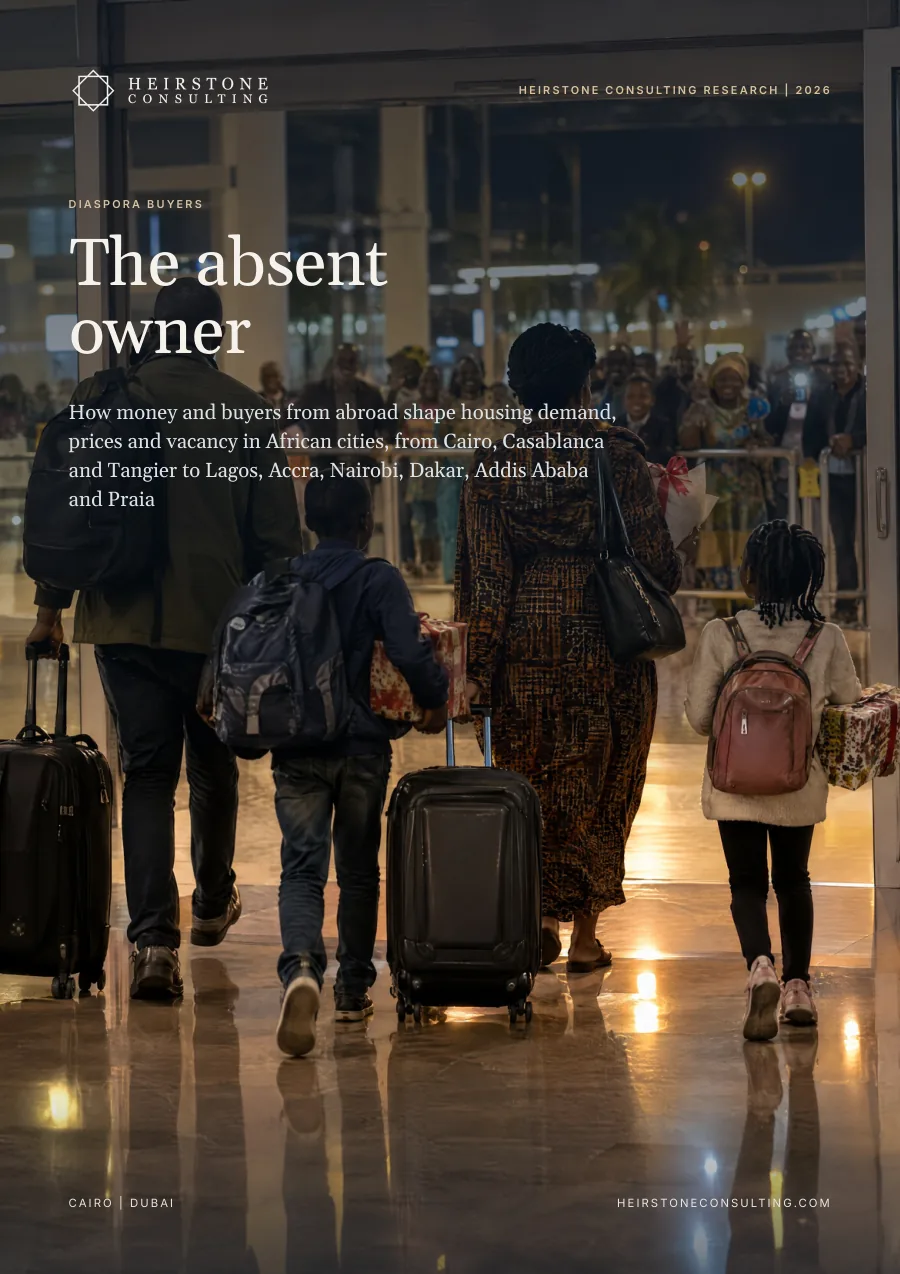
Cover of the Heirstone Consulting Research report Diaspora Buyers: The absent owner

The report in six numbers

US$36.5bn

sent home by Egyptians abroad in the fiscal year to June 2025, a record and 66% more than a year earlier (Central Bank of Egypt)

9.9x

Nigeria's remittances as a multiple of its net foreign direct investment, 2015 to 2024 combined (Heirstone analysis)

1.159m

homes closed because the household lives abroad, counted by Egypt's 2017 census, the only census we found in our twelve markets to measure them

38%

discount for buyers earning in dollars in New Cairo, where apartment asking prices rose 89% in pounds from May 2021 to March 2024

89%

bank deposits of Moroccans living abroad as a share of Morocco's outstanding housing loans, March 2026

29%

of Cabo Verde's dwellings were for seasonal use or vacant at the 2021 census

In brief

Africans abroad are a strong buyer and a weak occupier. They are a reliable source of sales and dollars for African housing, and a poor source of lived-in homes.

This report follows one buyer that appears in almost every African housing market and in almost no housing statistic: the citizen who lives abroad and buys at home. In most of the twelve markets we studied, from Egypt and Morocco to Nigeria, Ghana, Senegal, Kenya and Cabo Verde, remittances bring in more hard currency than foreign direct investment. Part of it goes into homes bought when the local currency is cheap and often occupied only on visits, and the products that work are priced in hard currency, paid in instalments, verifiable from abroad and managed while the owner is away.

  1. Remittances outweigh foreign investment in most diaspora markets, but still trail aid south of the Sahara.

    From 2015 to 2024 Nigeria received 9.9 times as much in remittances as in net foreign direct investment, Kenya 5.3 times and Morocco 4.0 times. In Sub-Saharan Africa, net aid of US$64.8bn exceeded recorded remittances of US$52.2bn in 2023.

  2. Recorded remittances jump when an exchange-rate gap closes.

    Egypt's recovered from US$19.5bn in 2023 to US$29.6bn in 2024 after the March 2024 exchange-rate unification. Ethiopia's recorded inflow rose thirteen-fold in 2024, the year it moved to a market-determined rate.

  3. No registry measures the diaspora share of home sales.

    The firmest numbers are programme counts: Moroccans abroad were 24% of the 75,760 recipients of Morocco's direct housing aid by November 2025, and one Nairobi scheme reports 25% diaspora buyers. The 70 to 80% of Lagos and Abuja developer sales cited by an estate firm cannot be verified.

  4. In devaluing markets the diaspora buys at a discount, which starts to close within about a year.

    New Cairo apartment asking prices rose 89% in pounds between May 2021 and March 2024, which gave buyers earning in dollars a 38% discount. By June 2025 the dollar price had recovered 20% from its low, and over 18 years Nairobi suburban house prices doubled in shillings and rose about 9% in dollars.

  5. A large part of what the diaspora builds stands empty.

    Egypt's 2017 census counted 1.159 million homes closed because the household lives abroad, about one for every eight Egyptians abroad. Morocco's urban secondary homes rose from 9.3% to 15.5% of the stock between 2014 and 2024, and in Cabo Verde 29% of dwellings were seasonal or vacant in 2021.

  6. States now sell to their diaspora in dollars, or bank its savings.

    Egypt's dollar-priced plots for citizens abroad have generated between US$7.3bn and US$10bn since 2012, depending on the source, and Nigeria's 2017 diaspora bond raised US$300m. Moroccans abroad hold MAD 228bn (about US$24bn) of deposits at home, equal to 89% of the country's housing loans.

What it means

Recommendations by audience

Governments and land agencies

Count the diaspora home, as Egypt's census does, and treat closed homes as supply. Letting or managing part of the 1.159 million would add usable housing alongside new dollar launches.

Developers

Price in hard currency or index to it, sell in instalments, report progress to buyers abroad and offer management for the months the owner is away.

Banks and payment providers

Lend in the currency the buyer earns, offer property-sized transfers with published prices and link diaspora deposits to housing finance.

Lenders and investors

Underwrite the exchange rate and the visit pattern as well as the rent.

Inside the full report

30 pages of evidence, benchmarks and tests

  1. Bigger than FDI, smaller than aid
  2. Four ways to buy from abroad
  3. The devaluation discount
  4. Closed because the family is abroad
  5. Selling to citizens abroad
  6. The Heirstone Diaspora Housing Monitor
  7. What to do

Heirstone datasets

12

markets in the Heirstone Diaspora Housing Monitor, from Egypt and Morocco to Nigeria, Senegal, Kenya and Cabo Verde

4

types of diaspora buyer in the Heirstone typology: the plot builder, the summer family, the remote investor and the dollar saver

6

questions in the Heirstone test to put to any developer, land agency or lender before a diaspora launch

Built from public sources current at October 2026. Every figure is referenced in the report, and figures we derive by combining published numbers are labelled Heirstone analysis.

Frequently asked questions

Do remittances to Africa exceed foreign direct investment?

In most diaspora markets, yes: from 2015 to 2024 Nigeria received 9.9 times as much in remittances as in net FDI, Kenya 5.3 times and Morocco 4.0 times. Across Sub-Saharan Africa, though, net aid of US$64.8bn still exceeded recorded remittances of US$52.2bn in 2023.

Is it cheaper to buy property in Egypt from abroad after the devaluation?

Yes, for a while. New Cairo asking prices rose 89% in pounds between May 2021 and March 2024, which gave buyers earning in dollars a 38% discount, but by June 2025 the dollar price had recovered 20% from its low.

What is Egypt's Bait Al Watan scheme for Egyptians abroad?

It is a state programme that has sold serviced plots to Egyptians abroad, priced and paid in dollars, since 2012, generating between US$7.3bn and US$10bn depending on the source. In October 2025 the government set a target of up to US$7bn over four years from more than 18,000 further plots.

Real Estate Strategy

How we can help

Explore the practice

Heirstone Consulting Research

More from The Africa Series

All reports

Discuss Your Mandate

Speak directly with a senior partner about your project, asset or programme.

Get in Touch

Heirstone Consulting Research

Get the full report

Enter your details and we will email you a personal download link. Please use an address you can open: the report is sent only to that inbox.