Home Real Estate Strategy Tourism Development National Vision Strategy Special Projects Digital Transformation Experience Reports Insights About Us Services Contact
Englishالعربية中文日本語EspañolFrançaisItalianoPortuguêsΕλληνικάDeutschSuomiDanskRomânăKiswahiliРусскийКыргызчаҚазақшаTürkçe

Heirstone Consulting Research · The Africa Series · October 2026

Hotel Development in Africa: Hotels on paper

Why Africa's chain hotel pipeline has never been larger while the rooms opened each year fell by more than half between 2017 and 2023, with a test for telling a hotel that will open from one that will not, from Egypt and Morocco to Nigeria, Ghana, Kenya and Ethiopia.

29 pages · PDF · English and French · Free

Also available in French: Développement hôtelier en Afrique: Des hôtels sur le papier. Choose the language when you request the report.
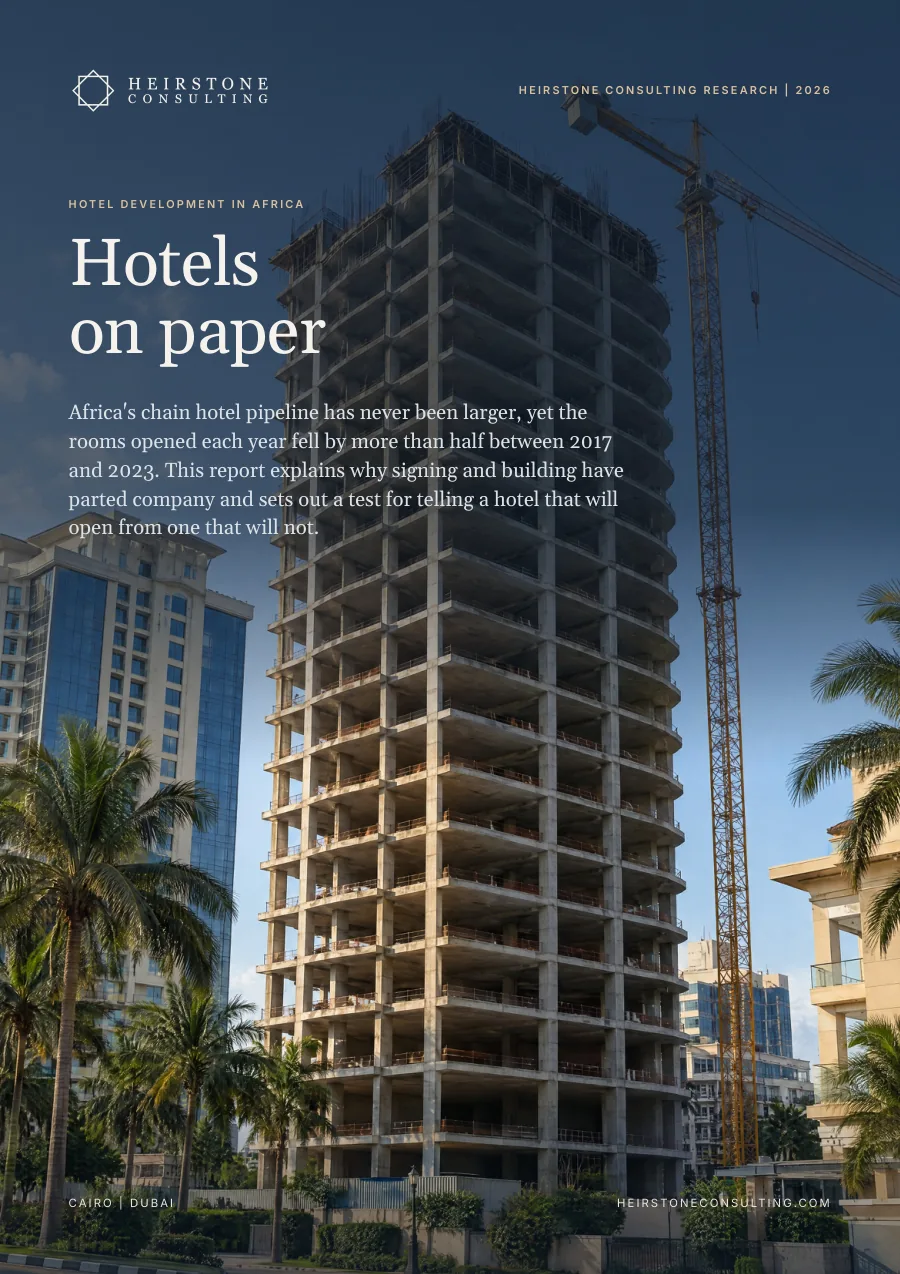
Cover of the Heirstone Consulting Research report Hotel Development in Africa: Hotels on paper

The report in six numbers

123,846

rooms in 675 hotels in the chains' African development pipeline in early 2026, a record and 19% more than a year earlier

3,458

rooms opened by the chains across Africa in 2023, against 8,053 in 2017

38%

of the 986 pipeline hotels scheduled to open between 2014 and 2023 that opened in their scheduled year

17-26 yrs

to open the 2026 pipeline at the average rates at which rooms opened in 2016-2023 and in 2020-2023

US$240k

median cost per key of eight IFC-financed new-build hotels, 2007-2026, against US$100,000 to 150,000 to acquire and upgrade (Heirstone analysis)

0

chain hotels in the survey opening lists for 2022 and 2023 in Nigeria, Côte d'Ivoire, Ghana and Uganda, which held 13,123 pipeline rooms in 2023

In brief

Africa's hotel pipeline keeps growing while openings shrink. In our analysis, the cost of capital explains the gap better than demand does.

We set W Hospitality Group's annual surveys of chain hotel pipelines against what actually opened, across 43 African countries from Egypt and Morocco to Nigeria, Ghana, Kenya and Ethiopia. The pipeline is a register of signed agreements, and in most African markets it has stopped working as a forecast of rooms. Most of the hotels that do open are resorts and conversions, or belong to owners who hold the equity and borrow in the currency the hotel earns.

  1. Signing and opening have moved in opposite directions.

    W Hospitality Group counted a record 123,846 pipeline rooms in early 2026, 70% more than in 2017, while rooms opened fell from 8,053 in 2017 to 3,458 in 2023. Of 986 hotels scheduled for 2014 to 2023, 379 opened on time.

  2. Reported construction is a weak signal.

    Every survey from 2018 to 2024 put 52 to 57% of pipeline rooms on site. Yet seven of 13 Lagos hotels listed as under construction were closed sites in early 2024, and Ghana, 82.6% on site in 2023, opened no chain hotel in 2022 or 2023.

  3. The pipeline sits in big cities; the openings are at resorts.

    Leisure destinations took 58% of the 8,256 chain rooms opened in 2022 and 2023. The six largest sub-Saharan city pipelines, with 17,887 rooms, delivered 361, while Egypt, with 28% of Africa's pipeline, opened a fifth of new chain rooms, after Morocco.

  4. Local-currency debt is too dear for most new keys.

    IFC-financed new builds cost a median of about US$240,000 per key. In our illustration, a key at the 2019 pipeline average of US$308,700 would need US$186 to 205 of RevPAR a night to pay interest alone at 22 to 24%, over three times Southern Sun's US$56.

  5. Delivery was strongest where the currency held.

    Of twelve countries measured, every one that delivered a fifth or more of its pipeline in 2022-2023, Tanzania, Morocco, Senegal, Rwanda and South Africa, had a dollar-priced key costing under twice as much local currency as in 2015. A key priced at US$308,700 cost NGN61.4m at the end of 2015 and NGN409.6m in September 2026.

  6. Buying and converting is the faster route.

    Acquire-and-upgrade deals in IFC disclosures cost US$100,000 to 150,000 per key, 40 to 60% of the new-build median, and conversions can open in the year they are signed. About 65% of IFC's hotel commitments since 2020 went to deals mainly about existing hotels.

What it means

Recommendations by audience

Tourism authorities and investment agencies

Plan capacity on rooms that are funded and verified on site, and count conversions towards room targets.

Owners and developers

Sign a flag once equity, site and matched debt are in place, and price an existing hotel before a new one.

Lenders and DFIs

Treat a signed agreement as an option and lend against verified progress, long tenors and matched currency.

Hotel operators

Report how many signed hotels open, alongside how many they sign.

Inside the full report

29 pages of evidence, benchmarks and tests

  1. A count of signatures
  2. Inside the pipeline
  3. The Heirstone Pipeline Reality Benchmark
  4. The arithmetic of a key
  5. The hotels that open
  6. North Africa and Sub-Saharan Africa
  7. The Heirstone Opening Test and what to do

Heirstone datasets

43

countries in the Heirstone Pipeline Reality Benchmark, which sets each chain pipeline against what it delivered

58

chain hotels with 8,256 rooms in Heirstone's register of openings in 2022 and 2023, classified by location

7

questions in the Heirstone Opening Test, which places a signed hotel in one of four states and says how to count its rooms

Built from public sources current at October 2026. Every figure is referenced in the report, and figures we derive by combining published numbers are labelled Heirstone analysis.

Frequently asked questions

How many hotel rooms are in Africa's development pipeline?

A record 123,846 rooms in 675 hotels in early 2026, according to W Hospitality Group, 19% more than a year earlier. Openings have gone the other way: the chains opened 3,458 rooms in 2023, against 8,053 in 2017.

Why do so many hotel projects in Africa not open?

Mainly because of the cost of capital. In Heirstone's illustration, a key at the 2019 pipeline average of US$308,700 would need US$186 to 205 of RevPAR a night to pay interest alone at local rates of 22 to 24%, over three times Southern Sun's US$56, and W Hospitality has named finance as the main cause of delay since at least 2017.

How much does it cost to build a hotel in Africa per key?

Eight IFC-financed new-build hotels from 2007 to 2026 cost between about US$168,000 and US$476,000 per key, with a median of about US$240,000. Buying and upgrading an existing hotel cost US$100,000 to 150,000 per key in IFC disclosures, 40 to 60% of the new-build median.

Real Estate Strategy

How we can help

Explore the practice

Heirstone Consulting Research

More from The Africa Series

All reports

Discuss Your Mandate

Speak directly with a senior partner about your project, asset or programme.

Get in Touch

Heirstone Consulting Research

Get the full report

Enter your details and we will email you a personal download link. Please use an address you can open: the report is sent only to that inbox.