Home Real Estate Strategy Tourism Development National Vision Strategy Special Projects Digital Transformation Experience Reports Insights About Us Services Contact
Englishالعربية中文日本語EspañolFrançaisItalianoPortuguêsΕλληνικάDeutschSuomiDanskRomânăKiswahiliРусскийКыргызчаҚазақшаTürkçe

Heirstone Consulting Research · The Africa Series · October 2026

Universities and Student Housing in Africa: The bed behind the seat

Africa's 18 to 24 year-olds, the universities competing to teach them and the economics of the student bed in 15 countries, from Cairo and Algiers to Lagos, Nairobi and Pretoria.

28 pages · PDF · English and French · Free

Also available in French: Universités et logement étudiant en Afrique: Le lit derrière la place. Choose the language when you request the report.
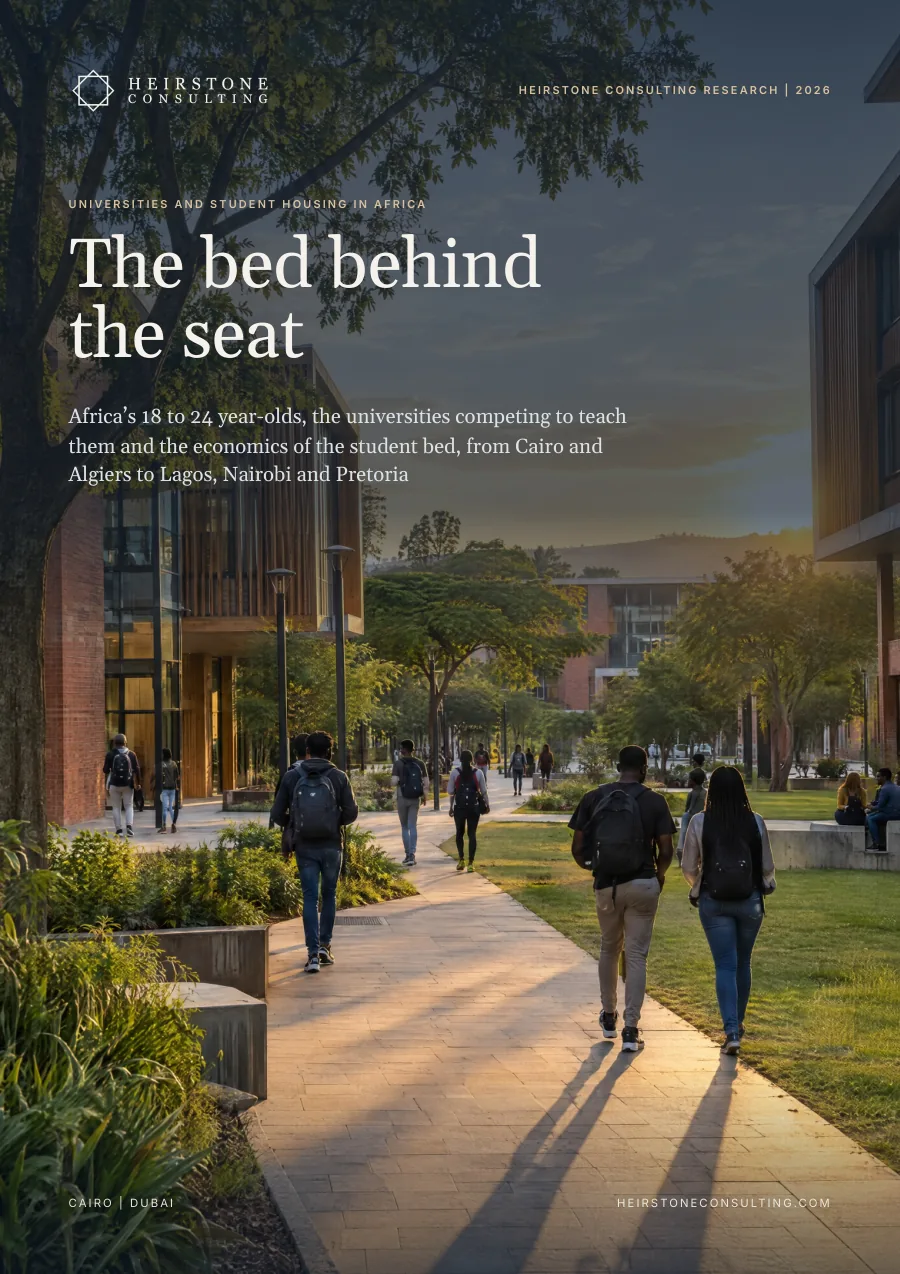

Cover of the Heirstone Consulting Research report Universities and Student Housing in Africa: The bed behind the seat

The report in six numbers

29.8m

more people aged 18 to 24 in the 15 countries of the report in 2035 than in 2025 (126.4m to 156.2m), on World Bank projections

2.8m

extra university seats needed by 2035 to hold today's enrolment ratios in the 12 countries with current UNESCO data

125,128

international students in Egypt in 2024, up 79% in two years, against 68,024 Egyptians studying abroad in 2023

182

private universities in Nigeria in 2026, up from 79 in 2019 and 55.5% of all its universities

US$110

monthly rent for an affordable Nairobi student bed, about 87 to 90% of Kenya's monthly minimum wage

6.7%

EPRA net initial yield on Acorn's stabilised Nairobi student-housing portfolio in 2025, at 81% average occupancy

In brief

Africa is adding university places faster than beds. Where data exists, the beds that fill are near a campus and most new ones rent below the minimum wage.

The 15 countries in this report, from Egypt, Morocco and Algeria to Nigeria, Kenya and South Africa, will have 29.8 million more people aged 18 to 24 in 2035 than in 2025. Governments and private universities are adding places to seat them. Far less is being built, or even counted, to house them. Where returns can be checked, in Nairobi, the student housing that performs is close to campus and priced for what students or their funders can pay.

  1. Keeping pace needs 2.8 million seats.

    In the 12 countries with current UNESCO data, holding today's gross enrolment ratios to 2035 needs about 2.8 million extra university seats, two thirds of them in Egypt and Algeria. Holding every ratio and lifting those below 20% to that floor needs about 5.4 million. With Nigeria, Ethiopia and Uganda added on estimated bases, reaching 20% everywhere needs about 11.5 million.

  2. Demand is leaking abroad, and part of it can be won back.

    Nigeria had 146,286 students abroad in 2023, more than double 2019. Students abroad equal 9.6% of domestic enrolment in Tunisia, 8.1% in Cameroon and 6.8% in Senegal. Egypt has moved the other way: it hosted 125,128 international students in 2024 against 68,024 Egyptians studying abroad.

  3. Licences are running ahead of housing.

    Nigeria's private universities rose from 79 in 2019 to 182 in 2026, and Egypt's New Administrative Capital hosts four branch-campus hubs, the largest cluster we found in Africa. Kenya is the only market where beds per student could be computed, at 44.5 per 100, and a Durban campus planned for 8,000 students includes 500 beds.

  4. Occupancy follows access to campus.

    Acorn's stabilised Nairobi portfolio averaged 81% occupancy in 2025: 94% in four core assets and 62% in three pilot assets. Its emptiest block, at 48%, sits just beyond 2.5 km from the main institutions, while the two near USIU-Africa ran at 94 and 95%.

  5. The rent has to fit whoever pays it.

    An affordable Nairobi bed costs about US$110 a month, 87 to 90% of Kenya's monthly minimum wage, and three in four beds Acorn's development REIT has opened are in that tier. A Gauteng sharing bed costs 111% of South Africa's minimum wage, and on-campus rooms at AUC and Ashesi about 1.9 and 4.2 times the local minimum wage.

  6. Nairobi builds beds for less than South Africa's state programme.

    Acorn's premium Qwetu schemes cost about US$12,500 to 15,100 a bed to develop and its mid-priced Eldoret scheme about US$8,100. South Africa's Student Housing Infrastructure Programme completed 11,407 beds in its first phase at about US$18,400 a bed.

What it means

Recommendations by audience

Ministries and regulators

License beds alongside seats and publish what exists: residence capacity, accredited private beds and rents. Use per-bed cost benchmarks in public-private tenders.

Universities and branch-campus sponsors

Secure a housing partner before the first intake, and offer land, referral agreements or a head lease in return.

Developers and operators

Choose the campus before the city, build two or three price tiers in one scheme, and design for a second use where the cohort will shrink, as in Tunisia and Morocco after 2035.

Investors, DFIs and banks

Underwrite the anchor campus and the rent-to-wage ratio, lend in the currency of the rent and treat national bed-deficit estimates as background.

Inside the full report

28 pages of evidence, benchmarks and tests

  1. 2.8 million seats to keep pace
  2. The students who leave, and the campuses chasing them
  3. The Heirstone Student City Benchmark
  4. What a bed earns
  5. The Heirstone Student Bed Test
  6. North Africa and Sub-Saharan Africa
  7. Plan the bed with the seat

Heirstone datasets

15

countries in the Heirstone Student City Benchmark, from Algiers to Pretoria, sorted into five types of student system

6

tests in the Heirstone Student Bed Test, each drawn from published operating data: anchor, rent fit, runway, cost, capital and exit

Built from public sources current at October 2026. Every figure is referenced in the report, and figures we derive by combining published numbers are labelled Heirstone analysis.

Frequently asked questions

How many university places does Africa need by 2035?

About 2.8 million extra seats to hold today's enrolment ratios in the 12 countries with current UNESCO data, two thirds of them in Egypt and Algeria. Reaching a 20% ratio in all 15 countries in the report, with Nigeria, Ethiopia and Uganda on estimated bases, needs about 11.5 million.

What returns does student housing earn in Nairobi?

Acorn's stabilised Nairobi portfolio earned a 6.7% EPRA net initial yield in 2025 at 81% average occupancy, with gross income about 9.6% of property value. Affordable beds rent for about US$110 a month, and premium beds cost about US$12,500 to 15,100 each to build.

How much does student accommodation cost in Egypt, Nigeria and South Africa?

A double room at AUC in New Cairo costs about US$250 a month, housing at the American University of Nigeria in Yola US$51 to 92, and a Respublica sharing bed in Gauteng about US$348, or 111% of South Africa's minimum wage. An affordable Nairobi bed costs about US$110.

Real Estate Strategy

How we can help

Explore the practice

Heirstone Consulting Research

More from The Africa Series

All reports

Discuss Your Mandate

Speak directly with a senior partner about your project, asset or programme.

Get in Touch

Heirstone Consulting Research

Get the full report

Enter your details and we will email you a personal download link. Please use an address you can open: the report is sent only to that inbox.