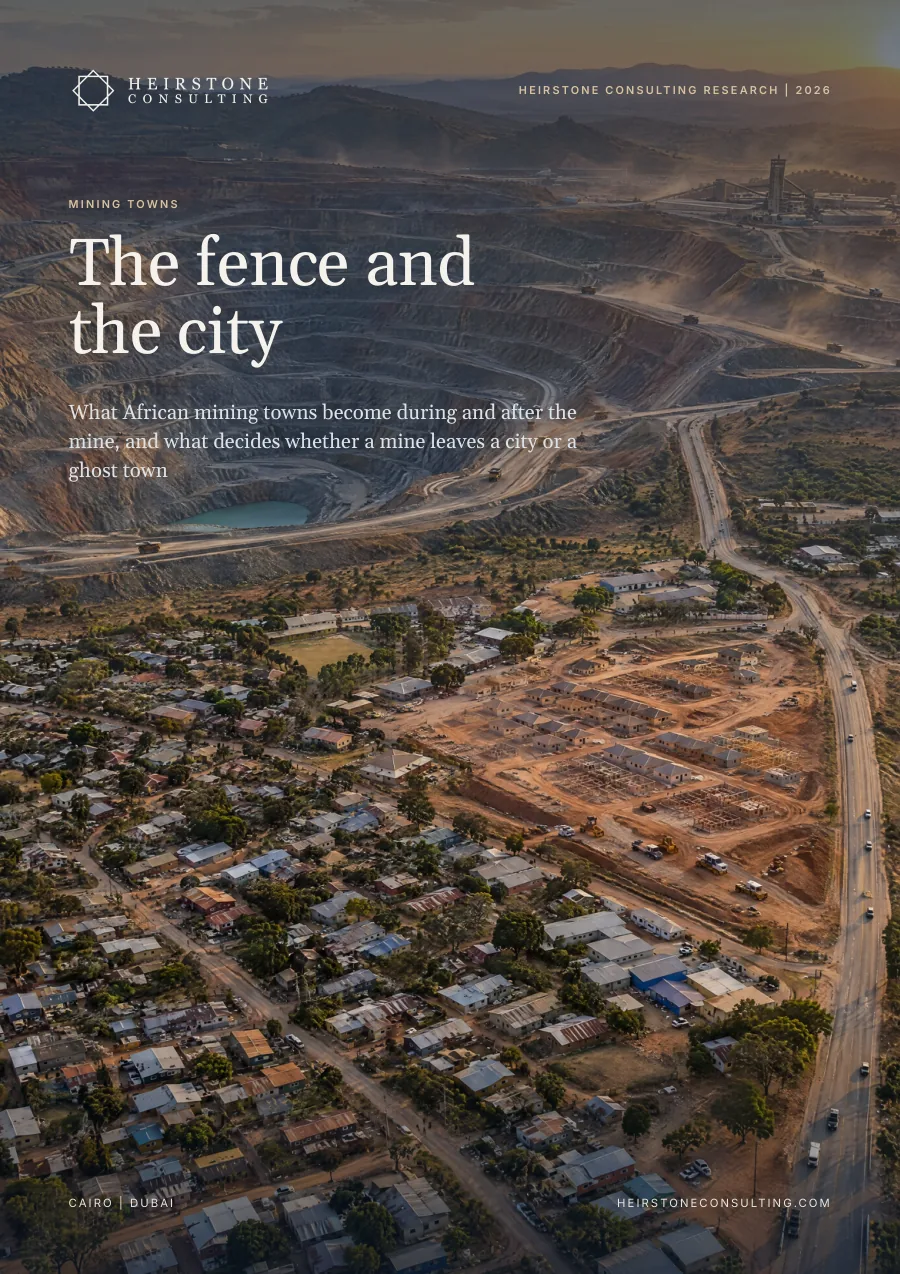
What African mining towns become during and after the mine, and what decides whether a mine leaves a city or a ghost town, from the Zambian and Congolese Copperbelt to Botswana, Ghana, Tanzania, Morocco and Guinea.
Also available in French: Villes minières: La clôture et la ville. Choose the language when you request the report.
The report in six numbers
mining towns in the Heirstone Mining Town Panel that grew faster than their country's urban population over the same census years. Six shrank.
towns in the panel that lost residents were company towns, built by or for a single operator (Heirstone classification)
growth of Solwezi, host town of the Kansanshi copper mine in Zambia, between the 2000 and 2022 censuses: 38,121 to 301,370, the 2022 count compiled from ward data
Simandou's construction peak of over 60,000 workers against fewer than 15,000 needed to run its mines, railway and port in Guinea, as reported by Reuters
of the legal royalty share due in Katanga reached it in 2014. Ghana's mining fund received about 38% of its due share that year, on cash figures that may mix years.
change in the population of Orapa, Debswana's closed town in Botswana, from 2011 to 2022, while Letlhakane, the open village next door, grew 38%
In brief
We followed 28 African mining towns in ten countries, from the phosphate towns of Morocco and Tunisia to the Copperbelt, Botswana, Ghana and Tanzania, through two censuses each and compared their growth with their country's urban population. Mine size and mine life do not sort the towns. What separates the cities from the stranded towns is whether people can live and build outside the operator's fence, whether the town has a function that does not depend on the mine, and whether it was planned for the workforce that stays after construction.
Only 8 of the 28 towns in the panel outgrew their national urban population. Solwezi in Zambia grew 9.9% a year against 4.3% for urban Zambia, while Jwaneng in Botswana, with about 20 years of mining ahead, grew 0.4% a year.
In Botswana, fenced Orapa lost 9% of its residents between 2011 and 2022 while Letlhakane, the open village next to it, grew 38%. All six towns that lost residents were company towns, and Oranjemund in Namibia nearly doubled after it opened to the public in 2017.
Simandou employed more than 60,000 workers at its construction peak and needs fewer than 15,000 to operate, according to Reuters, which also reported that 8,000 of 10,000 workers in the rail town of Dantilia lost their jobs within three months.
Where the amount due and the amount paid are both published, 37 to 38% arrived: Katanga province and Ghana's Minerals Development Fund, both in 2014. Even paid in full, Ghana's local share is about 0.5% of gross mineral sales, and Zambia earmarks nothing for host areas.
None of the closures reviewed emptied its town. Selebi-Phikwe lost 14% of its residents between 2011 and 2022 after BCL closed in 2016, about 1.3 residents per BCL job, and replacement jobs reached 26 to 31% of those lost three years after closure.
Kimberley became a provincial capital 80 years after the Big Hole closed and gained a university a century after. At Ben Guerir, OCP is building a Green City for 100,000 residents around a university, and the closed Buzwagi gold mine at Kahama is becoming a special economic zone.
What it means
Zone open, titled land for the town before the mine is built, and publish each year how much of the host share arrived.
House the operating workforce permanently, treat the construction peak as temporary, and hand land and houses to residents well before closure.
Ask for a town land plan and a construction-to-operations workforce ratio alongside the environmental and social case.
Favour open towns with a second function, such as Solwezi, Kahama, Geita, Tarkwa and Ben Guerir, and underwrite to the operating workforce.
Inside the full report
Heirstone datasets
towns in ten countries in the Heirstone Mining Town Panel, each with two census counts set against national urban growth
town types in the Heirstone Mining Town Typology, from corridor town and company town to diversified city
questions in the Heirstone city-after-the-mine test, applied to six towns and corridors from Simandou to Ben Guerir
Built from public sources current at October 2026. Every figure is referenced in the report, and figures we derive by combining published numbers are labelled Heirstone analysis.
Most fall behind their country's cities. Only 8 of 28 African mining towns in the Heirstone panel grew faster than their national urban population, and six lost residents, all of them company towns.
In the cases Heirstone reviewed, the town shrinks to what other employers and public functions can support but does not empty. Selebi-Phikwe in Botswana lost 14% of its residents between 2011 and 2022 after BCL closed in 2016, about 1.3 residents per job lost.
Where both sides are published, 37 to 38% of the amount due arrived: Katanga in the DRC and Ghana's Minerals Development Fund, both in 2014. Ghana's local share is about 0.5% of gross mineral sales even when paid in full, and Zambia earmarks none.
Real Estate Strategy
Heirstone Consulting Research
Speak directly with a senior partner about your project, asset or programme.
Get in Touch