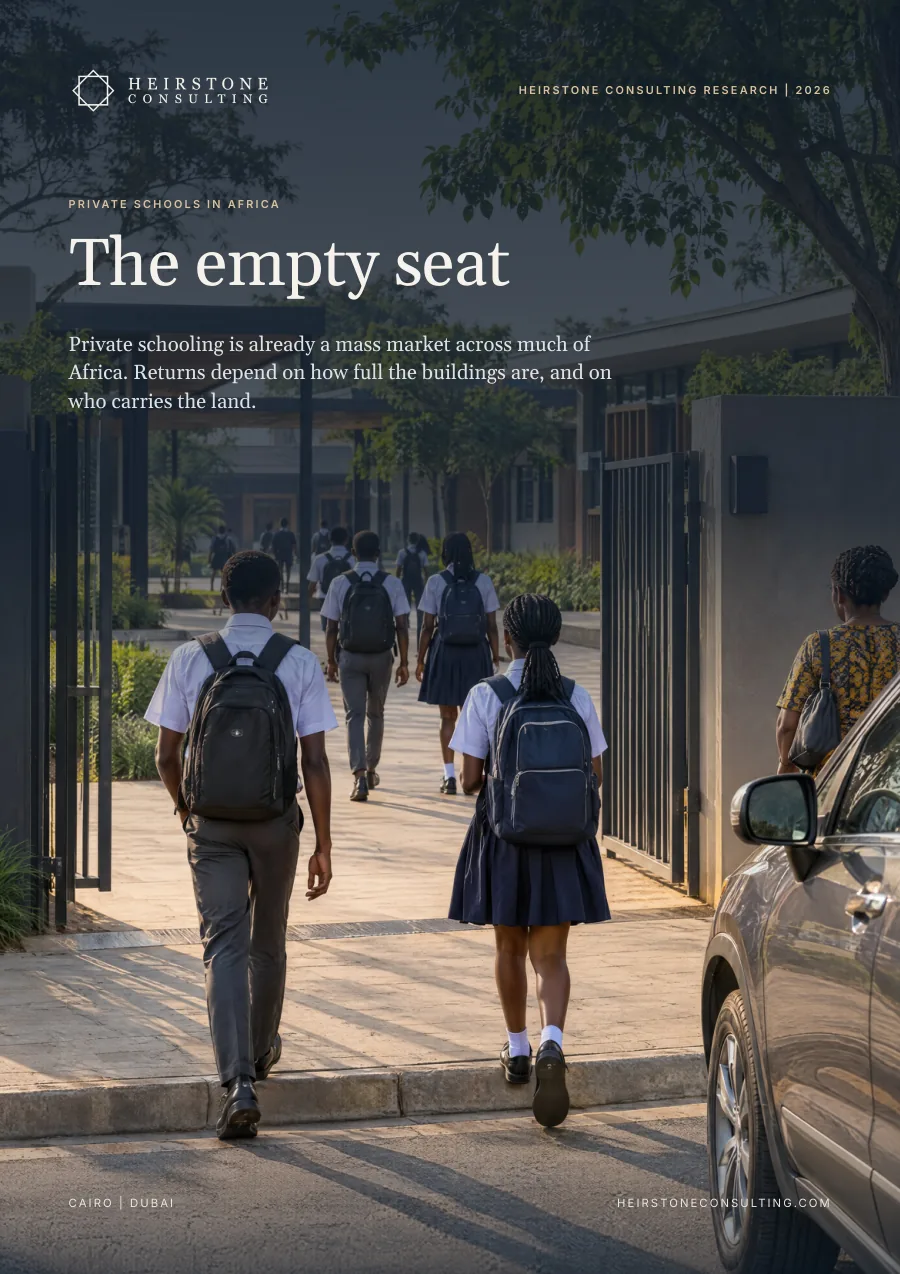
Private primary and secondary schools in Africa read as real estate: seats, land, capital per place and tenure across 13 markets, from Egypt and Morocco to Nigeria, Côte d'Ivoire, Kenya and South Africa.
Also available in French: L’enseignement privé en Afrique: La place vide. Choose the language when you request the report.
The report in six numbers
of Côte d'Ivoire's secondary pupils are in private schools, the highest share of any country in the report; its population aged 15 to 19 grows 25.6% by 2035
private primary and secondary pupils in Nigeria, Ghana, Côte d'Ivoire and Cameroon (Heirstone analysis); we found no listed school group in any of them
share of Curro's built seats in use in every year from 2018 to 2024; about 31,000 seats stood empty in 2024
book property per built seat at both Curro (2024) and ADvTECH (2025), equal to 1.2 to 1.5 years of fee or revenue per pupil (Heirstone analysis)
implied enterprise value in the 2025 take-private of Curro, as a multiple of its book property, plant and equipment (Heirstone analysis)
additional private pupil places in 13 markets by 2035 if primary private shares keep their trend; 2.7 million if shares are held constant (Heirstone scenarios)
In brief
This report reads private primary and secondary schools in 13 African markets as real estate: seats, land, buildings, capital per place and tenure. About 30 million pupils attend private schools across them, from Nigeria and Côte d'Ivoire to Egypt and South Africa, yet the schools investors can measure and buy are mostly in South Africa and Egypt. Read as real estate, the sector turns on one variable: how full a school is.
Côte d'Ivoire has 63% of its secondary pupils in private schools, and Ghana, Cameroon and Nigeria have 23 to 28% of their primary pupils. These four markets hold about 18.9 million private pupils. South Africa, at 5.8% of primary pupils, produced the two largest listed groups.
The population aged 5 to 19 in the 13 markets grows by 29 million to 2035, 62% of it in Ethiopia and Nigeria. Morocco's shrinks 6.5% and Tunisia's 14%. Egypt's holds steady while ages 15 to 19 add 1.5 million.
Curro grew average learners by 42% between 2018 and 2024 yet filled only 69 to 72% of its built seats each year, leaving about 31,000 empty in 2024, roughly R3.2bn (US$172m) of book property. ADvTECH fills 84% of its existing capacity and CIRA in Egypt 94%.
Curro (2024) and ADvTECH (2025) each hold about R100,000 of property, plant and equipment per built seat, or 1.2 to 1.5 years of fee or revenue per pupil. Curro's 2025 take-private implied 0.97 times its book property.
ADvTECH's schools elsewhere in Africa earned a 33.7% operating margin in 2025 against 20.9% at home, and recover their property in about 4.4 years of operating profit against 6.8. Regis Runda in Nairobi cost R85,600 per built seat, while South African extensions cost R114,000 to R138,000 per added place.
IFC states that it does not fund fee-charging private K-12 schools. The finance we found is local, asset-backed or philanthropic: CIRA's EGP 600m ijara sukuk on four schools in Egypt, a bank refinancing of Curro's low-fee Meridian schools and a foundation's purchase of Curro.
What it means
Reserve school land in the first phase of a community, build it in steps that pass 80% utilisation before the next is built, and price the plot as part of the demand plan.
Grow where seats already fill, often by buying and extending, and keep land off the operating balance sheet where tenure allows.
Hold school property let on long leases to proven operators, underwritten on seven years of utilisation history and rent cover tested at 70% and 85%.
Publish private enrolment and capacity every year, match registration tenure to the life of the buildings and publish the terms of school plots in new towns.
Inside the full report
Heirstone datasets
schools and groups in the Heirstone School Estate Benchmark, measured on seats, utilisation, land, property per seat, fees, margin, payback and tenure
questions in the Heirstone School Site Test, each with a pass mark, to answer before a school plot is signed
Heirstone School Estate Models, from owner-operator on freehold to state buildings with partner management
Built from public sources current at October 2026. Every figure is referenced in the report, and figures we derive by combining published numbers are labelled Heirstone analysis.
About 30.3 million primary and secondary pupils attend private schools in the 13 markets Heirstone examined, 40% of them in Nigeria. Côte d'Ivoire has 63.3% of its secondary pupils in private schools, yet the listed school groups are in South Africa and Egypt.
About US$5,600 of book property per built seat, roughly R100,000, at both Curro and ADvTECH in South Africa. Recent purchases of schools in Nairobi and Addis Ababa came in at US$2,500 to US$4,800 per seat or pupil, while extensions cost R114,000 to R138,000 per added place.
Because property per enrolled pupil rises steeply below 80% utilisation: at 70% each pupil carries about US$8,000 of property, at 94% about US$6,000. Curro filled 69 to 72% of its built seats from 2018 to 2024, while CIRA in Egypt uses 93.6% of its 40,000 seats.
Real Estate Strategy
Heirstone Consulting Research
Speak directly with a senior partner about your project, asset or programme.
Get in Touch