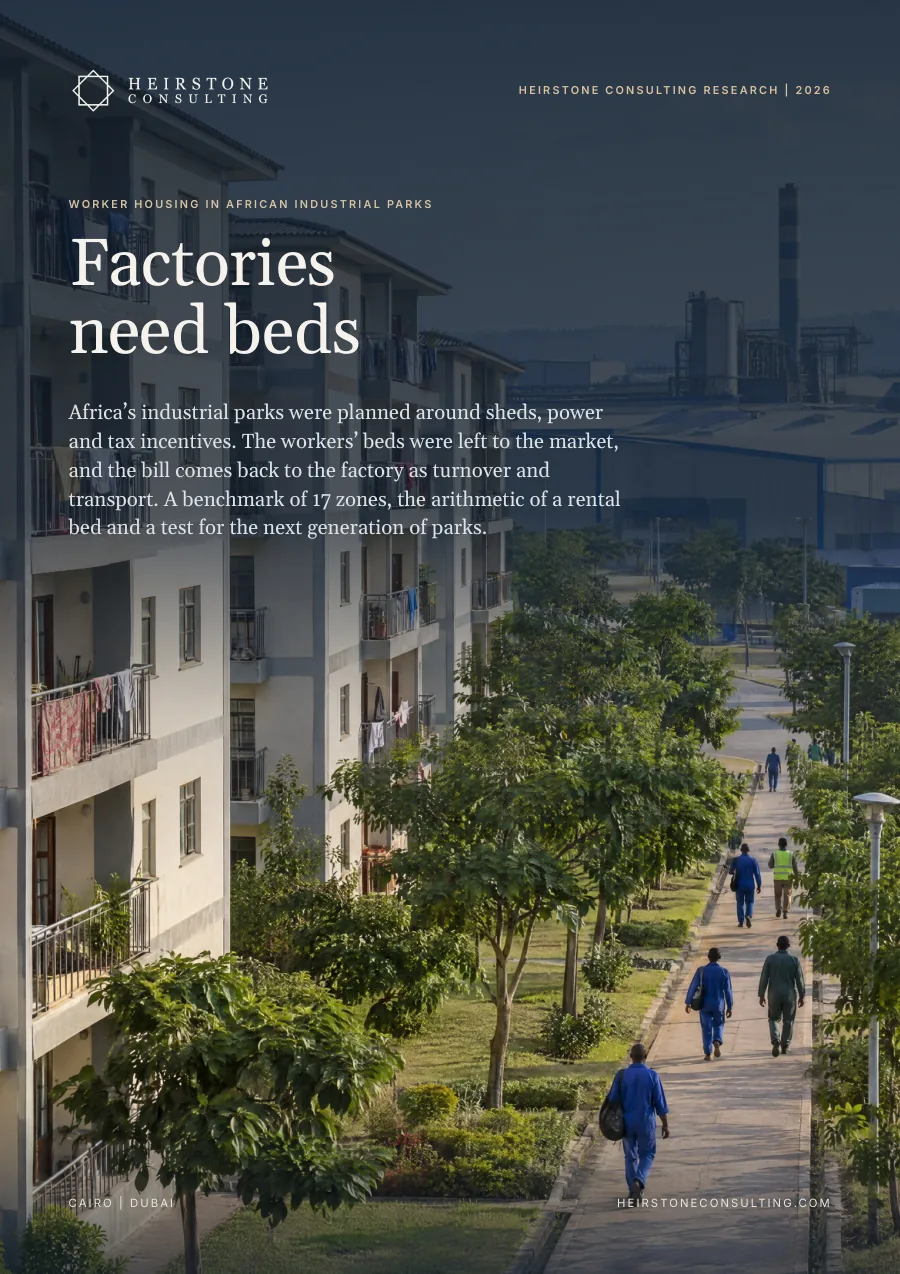
Africa's industrial parks were planned around sheds, power and tax incentives, and the workers' beds were left to the market. A benchmark of 17 zones in ten countries, from Ethiopia's Hawassa and Egypt's 10th of Ramadan to Tangier, Kenya and Benin, with the arithmetic of a rental bed.
Also available in French: Le logement des travailleurs dans les parcs industriels africains: Les usines ont besoin de lits. Choose the language when you request the report.
The report in six numbers
dedicated beds per 100 jobs at Ethiopia's Hawassa Industrial Park, where 91% of 33,199 workers came from outside the city
annual staff turnover reported by Hawassa employers in 2018-19, with between 5% and 10% of the workforce leaving every month
rent near Bole Lemi as a share of the 750-birr base wage in 2018, when the park had lost 7,840 workers in six months (Addis Fortune, citing IPDC)
cost per bed of a Bangladesh dormitory that found no tenants (62 to a room) and of an 18,720-bed hostel in Tamil Nadu (six to a room)
of Hawassa's 300 hectares would house its whole workforce at the density of Tamil Nadu's Vallam Vadagal hostel
monthly entry wage at which a rent of 20% of pay covers the capital charge on a US$2,100 to 4,500 bed, on assumed finance terms and excluding land and operating costs
In brief
African industrial parks bring tens of thousands of workers to places where they do not live. This report benchmarks 17 zones in ten countries, from Ethiopia's Hawassa and Bole Lemi to Egypt's 10th of Ramadan, Morocco's Tangier and Kenitra zones, Kenya and Benin's GDIZ. Their housing is left to private landlords, bus contracts or social housing elsewhere in town, and the cost reaches the factory as turnover, transport and lost output.
At Hawassa, Ethiopia's flagship park, up to 2,400 dedicated beds (2018) stood against 33,199 workers (2020), 91% of them from outside the city. Benin's GDIZ passed 25,000 jobs in 2026 with no worker housing reported, and no park operator in the benchmark publishes a bed count.
Hawassa employers reported 5 to 10% of staff leaving every month: 20,000 to 40,000 hires a year on 33,199 jobs, or 8 to 17 per dedicated bed. At Bole Lemi, 7,840 left in six months while nearby rents were about 120% of the base wage (Addis Fortune, citing IPDC).
A place in a shared room near Hawassa cost 31 to 37% of the 750-birr base wage, close to the 30% the IGC proposed for a low-cost dormitory. A room of one's own cost up to twice the wage, and some workers walked three hours a day.
Morocco's Atlantic Free Zone moved 25,300 workers with 480 minibuses. Tangier employers paid about EUR 25 a worker a month for buses in 2013, enough to service the capital on a bed costing US$3,400 to 5,100 at assumed rates of 6 to 10%.
A Bangladesh dormitory and a Tamil Nadu hostel each cost about US$4,500 a bed. The first, 62 beds to a room and let bed by bed by a government directorate, had no tenants after a year. The second, six to a room and run by the anchor employer, opened with 18,720 beds.
At the Tamil Nadu hostel's density, 5% of Hawassa's land would house every worker in the park. On assumed finance terms, a rent of 20% of pay covers a bed's capital charge once entry wages reach US$68 to 220 a month: Egypt, Tunisia and Morocco clear the bar, Benin is close, and Ethiopia and Nigeria need a payer.
What it means
Reserve 5 to 10% of gross park land for worker rental housing in the masterplan, and report beds per 100 jobs every year next to jobs and sheds.
Price the bed against turnover and buses, and lease beds for the share of staff who come from far away, folding existing housing and transport allowances into the lease.
Create the market cheaply through land rules, employer leases and part of existing housing levies, such as Kenya's, which raised KSh 73.2bn in the year to June 2025.
Finance employer-leased rental beds at the factory gate in local currency, starting where wages clear the threshold in Egypt, Morocco and Tunisia.
Inside the full report
Heirstone datasets
African zones in ten countries in the Heirstone Worker Housing Benchmark, plus two international reference dormitories
questions in the Heirstone bed test for any new industrial park or phase, from where the workforce comes from to land reserved in the masterplan
worker housing delivery models in the Heirstone typology, from state-built, employer-run hostels to payroll levy funds
Built from public sources current at October 2026. Every figure is referenced in the report, and figures we derive by combining published numbers are labelled Heirstone analysis.
Because most workers come from elsewhere and the cost of housing them returns to the factory as turnover. At Ethiopia's Hawassa park 91% of 33,199 workers came from outside the city, there were seven dedicated beds per 100 jobs, and employers reported 5 to 10% of staff leaving every month.
Plain dormitories in Ethiopia, Bangladesh and India have been budgeted or built at US$2,100 to 4,500 a bed. Projects that add malls, clinics and stadiums, such as Doha's Labour City at about US$12,000 a bed, cost three to six times as much.
Yes, for the capital cost on assumed finance terms. A rent of 20% of Egypt's EGP 7,000 minimum wage, EGP 1,400, covers the capital charge on a US$2,100 bed, and 20% of Morocco's MAD 3,111 minimum covers any of the reference beds, before land and operating costs.
Real Estate Strategy
Heirstone Consulting Research
Speak directly with a senior partner about your project, asset or programme.
Get in Touch