Home Real Estate Strategy Tourism Development National Vision Strategy Special Projects Digital Transformation Experience Reports Insights About Us Services Contact
Englishالعربية中文日本語EspañolFrançaisItalianoPortuguêsΕλληνικάDeutschSuomiDanskRomânăKiswahiliРусскийКыргызчаҚазақшаTürkçe

Heirstone Consulting Research · The Africa Series · October 2026

Digital Infrastructure Real Estate: Borrowed ground

Towers, fibre and the land beneath Africa's digital networks, and why the ground lease and the wayleave are their weak links, from Nigeria, South Africa and Kenya to Egypt, Morocco, Senegal and Côte d'Ivoire.

29 pages · PDF · English and French · Free

Also available in French: Immobilier des infrastructures numériques: Un sol d’emprunt. Choose the language when you request the report.
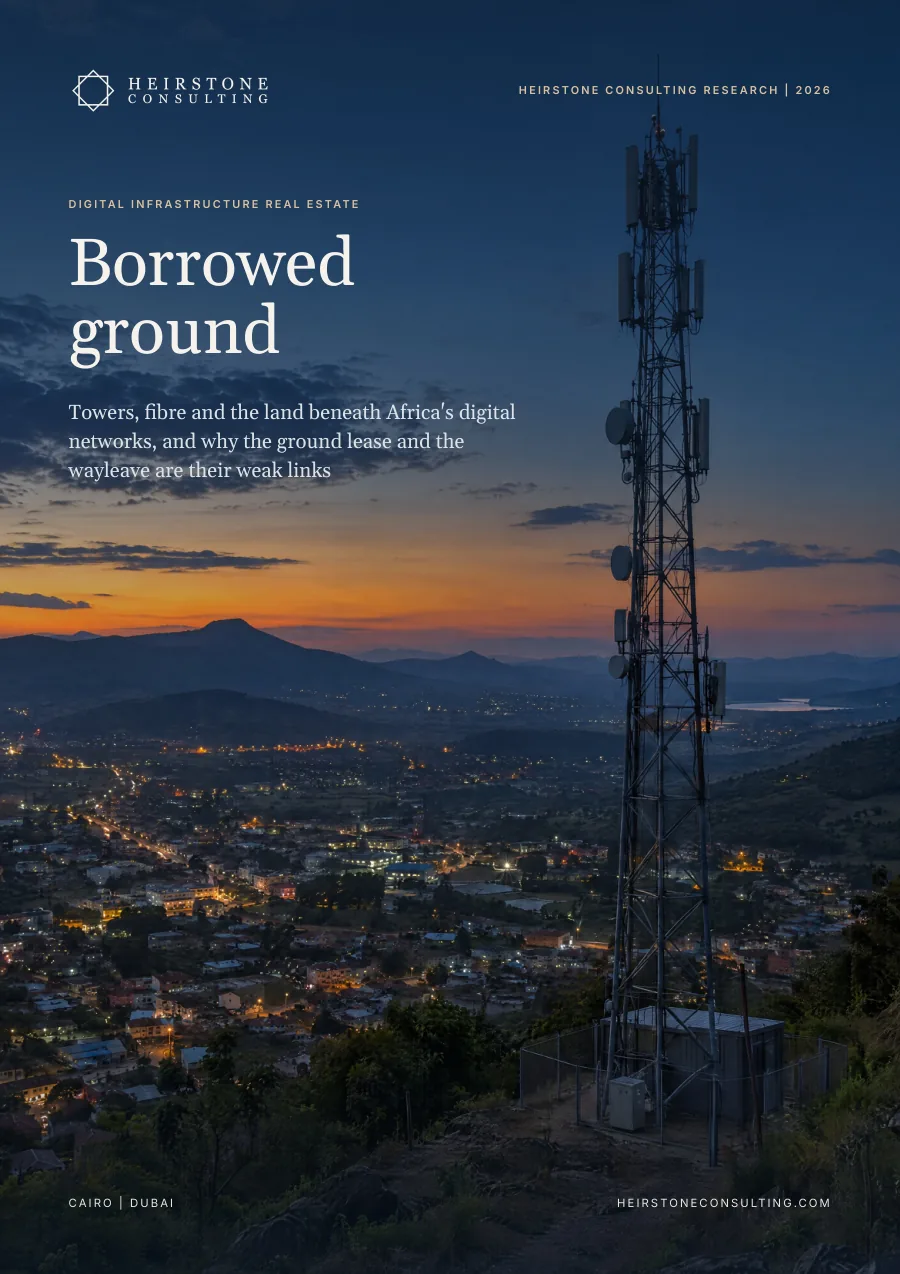
Cover of the Heirstone Consulting Research report Digital Infrastructure Real Estate: Borrowed ground

The report in six numbers

89%

of IHS Towers' sites stand on leased land, with 11.4 years left on average; SBA owns or controls 71% of its sites' land for more than 20 years

4x

power cost per tower site against ground rent: about US$12,600 to 14,300 a year against US$3,100 to 3,500

US$325k

value per site in the Eaton Towers deal (2019-20), against about US$72,500 for MTN South Africa's towers (2022)

28%

Ogun State's one-off fibre right-of-way charge as a share of Nigeria's average Project BRIDGE build budget per km, on TechCabal's 2025 figures; at least 7% on ALTON's

11 to 15x

revenue per km earned by Dark Fibre Africa (2025-26) against Kenya Power's dark fibre on its grid (2022-23)

116m

people per cable landing site in Nigeria, against 13m in Egypt, which spreads 24 systems, some still planned, over nine sites

In brief

Africa's towers and fibre are financed as long-life infrastructure, on land held for a fraction of that life. Much of the value still to be created lies in making those land rights longer, indexed and easier to aggregate, and in bringing power to the plot.

This report looks at African towers and fibre as real estate: the plots, rooftops, streets, corridors and beaches that digital networks occupy, from Nigeria, South Africa and Kenya to Egypt, Morocco, Senegal and Côte d'Ivoire. Investors buy tower and fibre businesses for their long, largely hard-currency contracts with mobile operators. The land rights under them run for a fraction of that time, are paid in local currency and are agreed one landowner, state or municipality at a time, and that mismatch matters more than the level of rent.

  1. The tower sits on a short lease.

    About 89% of IHS Towers' sites stand on ground leases with an average of 11.4 years left, and a third expire before the end of 2030. SBA Communications, a US-listed owner, holds 71% of its sites' land outright or for over 20 years, with 35 years of lease life left including renewal options.

  2. Buyers pay for tenants and contracts. The ground explains little of the price.

    African tower deals have valued sites at between about US$72,500 (MTN South Africa, 2022) and US$325,000 (Eaton Towers, 2019-20). Capitalised at 8 to 12%, a typical ground rent would account for 36 to 60% of the MTN South Africa price per site but only 8 to 13% of Eaton's.

  3. Power is the real occupancy cost.

    A tower site's power costs about US$12,600 to US$14,300 a year, four times its ground rent of US$3,100 to US$3,500. Power was 47.8% of IHS's cost of sales in 2025, with grid supply across Helios Towers' markets averaging 16 to 18 hours a day.

  4. In fibre, the permit can cost up to a quarter of the build.

    On TechCabal's 2025 compilation, Nigerian states charged from nothing to N9,477 per metre for right of way, which puts Ogun's one-off charge at about 28% of Project BRIDGE's average budget of US$22,200 per km. The N145 federal benchmark fell from about US$190 to US$94 per km between mid-2023 and mid-2025.

  5. City ducts earn far more than long corridors.

    Dark Fibre Africa earned 11 to 15 times more revenue per kilometre in 2025-26 than Kenya Power's dark fibre on its grid did in 2022-23, about US$770 per km a year. Vodacom's R12.64bn (US$712m) for 30% of Maziv implies US$813 to US$1,160 per home passed.

  6. Landing sites are few and concentrated.

    Nigeria's eight international cables land at two sites, one for every 116 million people, against one for every 13 million in Egypt, where 24 systems, some still planned, land at nine sites. Dakar, Accra and Abidjan each depend on a single landing site.

What it means

Recommendations by audience

Governments, regulators and land agencies

Publish one national right-of-way tariff, index it and collect it through one window. Reserve landing zones and duct routes in coastal, road and rail plans, and offer state land for tower sites on standard 20-year leases.

Landowners and corridor owners

Sell term, indexation and power before asking for more rent. Road, rail and power authorities should lease ducts on the urban approaches, where fibre earns, and price long-haul corridors as volume business.

Operators, investors and DFIs

Underwrite the lease-expiry profile and the currency of the land rights alongside tenancy. Lengthened and aggregated, the ground leases under African towers could become a local-currency asset for pension funds.

Inside the full report

29 pages of evidence, benchmarks and tests

  1. Eleven years left on the lease
  2. Tenants set the price
  3. Cheap ground, costly power
  4. The permit is the price
  5. Ducts, corridors and landing beaches
  6. North and Sub-Saharan Africa
  7. The landlord test

Heirstone datasets

14

tower portfolios in the Heirstone Site Economics Benchmark: ten African portfolios and four comparators, from IHS Nigeria to Eaton Towers

6

questions in the Heirstone Landlord Test, applied to five land rights from IHS ground leases to the Suez Canal crossing route

5

models for the right to dig in the Heirstone typology, from South Africa's statutory access to Nigeria's state-by-state charges

Built from public sources current at October 2026. Every figure is referenced in the report, and figures we derive by combining published numbers are labelled Heirstone analysis.

Frequently asked questions

How long are telecom tower ground leases in Africa?

Short: IHS Towers' ground leases had 11.4 years left on average at the end of 2025, and a third expire before the end of 2030. SBA Communications, a US-listed owner, has 35 years left including renewal options and holds 71% of its sites' land outright or for over 20 years.

How much does fibre right of way cost in Nigeria?

Anything from nothing to N9,477 per metre on TechCabal's May 2025 table of state charges, against a federal benchmark of N145. At the top rate Ogun's one-off charge is about US$6,114 per km, about 28% of Project BRIDGE's average build budget; ALTON's figures put Ogun at over N2,500 per metre, or at least 7%.

What is a telecom tower in Africa worth per site?

African tower deals have valued sites at between about US$72,500 (MTN South Africa, 2022) and US$325,000 (Eaton Towers, 2019-20). Tenancy, contract currency and bundled power explain the spread, and capitalised at 8 to 12% the ground rent accounts for only 8 to 13% of Eaton's price per site.

Real Estate Strategy

How we can help

Explore the practice

Heirstone Consulting Research

More from The Africa Series

All reports

Discuss Your Mandate

Speak directly with a senior partner about your project, asset or programme.

Get in Touch

Heirstone Consulting Research

Get the full report

Enter your details and we will email you a personal download link. Please use an address you can open: the report is sent only to that inbox.