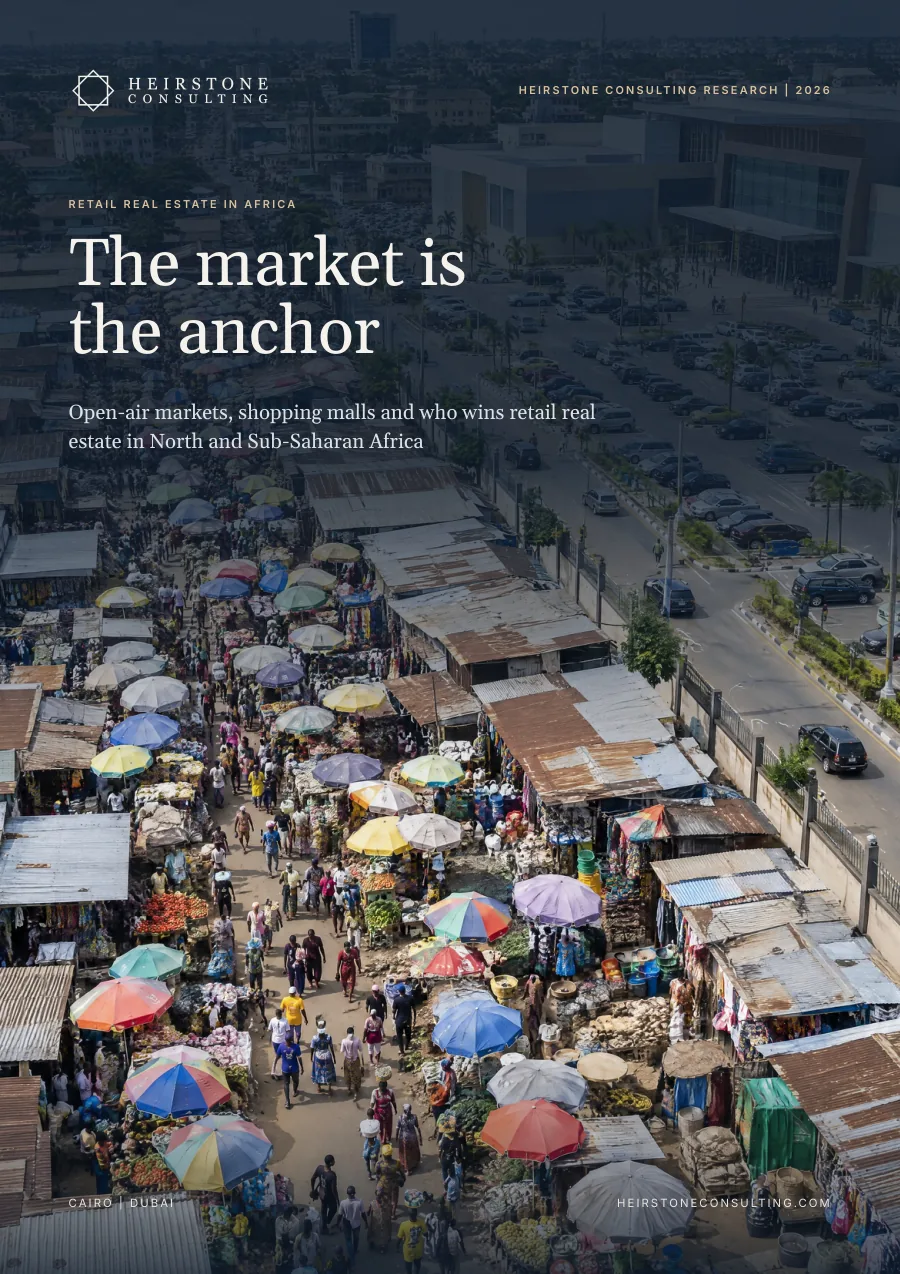
Open-air markets, shopping malls and who wins retail real estate in North and Sub-Saharan Africa, from Cairo and Casablanca to Lagos, Accra, Abidjan, Nairobi and Dar es Salaam.
Also available in French: L’immobilier commercial en Afrique: La vraie locomotive, c’est le marché. Choose the language when you request the report.
The report in six numbers
of Nigerian retail sales go through open-air markets. Supermarkets take 3% (USDA FAS, 2024).
trading places per hectare designed into Abidjan's Forum des marchés, against about 35 stores per hectare of lettable floor at Accra Mall (Wikipedia data; Heirstone analysis)
of previous income earned, on average, by 25 street vendors surveyed after their move out of Kejetia, Kumasi, for its rebuild (WIEGO, 2020)
change in Ikeja City Mall's US dollar value from its 2019 valuation to the value implied by its 2024 sale, while reported vacancy stayed at 2.1% or less
vacancy at Kumasi City Mall in June 2024, down from 32.2% a year earlier, as Melcom fitted out the whole unit Game had left (Hyprop)
of mall space per 1,000 residents in Greater Cairo, against about 12 m² for the two largest malls in Accra (Knight Frank; Heirstone analysis)
In brief
Outside South Africa, formal retail is a thin layer over a market economy. We built a register of 28 markets and 27 malls in 17 countries, from Cairo and Casablanca to Lagos, Accra, Abidjan and Nairobi, and traced 16 market redevelopments. Most trade happens in markets run or regulated by public bodies, at densities no mall approaches. The malls that have held their value are those whose rent is set in the currency their tenants earn and whose anchor space a local chain can take over.
Open-air markets take 72% of Nigeria's retail sales and supermarkets 3%, according to USDA FAS. Small grocers hold 83% of food retail in Ghana and 63% in Côte d'Ivoire, and Nigeria's six leading supermarket chains run about 90 outlets between them.
Abidjan's Forum des marchés was built for about 8,700 places per hectare, against about 35 stores per hectare of lettable floor at Accra Mall. All 18 markets in the register with a recorded owner or manager are held, run or regulated by a public body, and street-vendor tolls were estimated at 70% of Kumasi's own revenue.
Of 16 market redevelopments classified, the four rebuilt in place reopened as working markets. Kejetia in Kumasi added 8,420 stores with 500 tabletop places for some 5,000 street vendors, and vendors surveyed after their move earned about a quarter of their previous income.
Ikeja City Mall in Lagos reported vacancy of 2.1% or less from 2021 to 2024, yet its value fell from US$141m in 2019 to the US$85m implied by its 2024 sale. Its rents were indexed to the dollar, and the naira lost 79% of its dollar value over 2019 to 2024.
Game left Ghana on 31 December 2022. Within 18 months Kumasi City Mall's vacancy fell from 32.2% to 4.85% as Melcom took Game's whole unit, and Carrefour franchisees took over Shoprite's space or leases in Kenya and Uganda.
Greater Cairo has about 2.6 million m² of lifestyle mall space across 82 developments, about 115 m² per 1,000 residents, and added 183,730 m² in 2025. Morocco's Aradei reports 97% occupancy across 474,000 m² in 23 cities.
What it means
Count every trader, including tabletop and street vendors, before design. Rebuild in place and keep trade at ground level, because the fee base depends on the traders who return.
Set rent in local currency or cap the dollar indexation, and build anchor boxes that a local chain can take whole or split without structural works.
Plan distribution through markets and their wholesalers, and enter through franchise and local partners, who have outlasted owned subsidiaries.
Price the currency before the occupancy, back operating platforms and market-site partnerships, and budget for exits that take years.
Inside the full report
Heirstone datasets
named sites in the Heirstone Market and Mall Register: 28 markets and 27 malls in 28 cities and 17 countries
projects in the Heirstone Market Redevelopment Record, from Makola in 1979 to Onitsha in 2026
tests in the Heirstone Mall Viability Test: currency, anchor depth, box size, cost and footfall
Built from public sources current at October 2026. Every figure is referenced in the report, and figures we derive by combining published numbers are labelled Heirstone analysis.
Mostly through currency and anchor exits rather than empty space. Ikeja City Mall in Lagos stayed at 2.1% vacancy or less while its dollar value fell about 40%, because its rents were indexed to the dollar and the naira lost 79% of its dollar value over 2019 to 2024.
In Nigeria, 72% of retail sales go through open-air markets and 3% through supermarkets, according to USDA FAS. Small grocers hold 83% of food retail in Ghana and 63% in Côte d'Ivoire, while in South Africa supermarkets have about 75% of grocery.
Count every trader, then rebuild on the original site with trade kept at ground level and market density. The four markets in the Heirstone record that were rebuilt in place reopened as working markets, while relocation sites were under-used or never built.
Real Estate Strategy
Heirstone Consulting Research
Speak directly with a senior partner about your project, asset or programme.
Get in Touch