Branded Residences: Who keeps the premium
What a brand adds to a home after its fees and running costs, and where branded schemes fall short, with a view from the UAE, Egypt and Saudi Arabia.
30 pages · PDF · English · Free
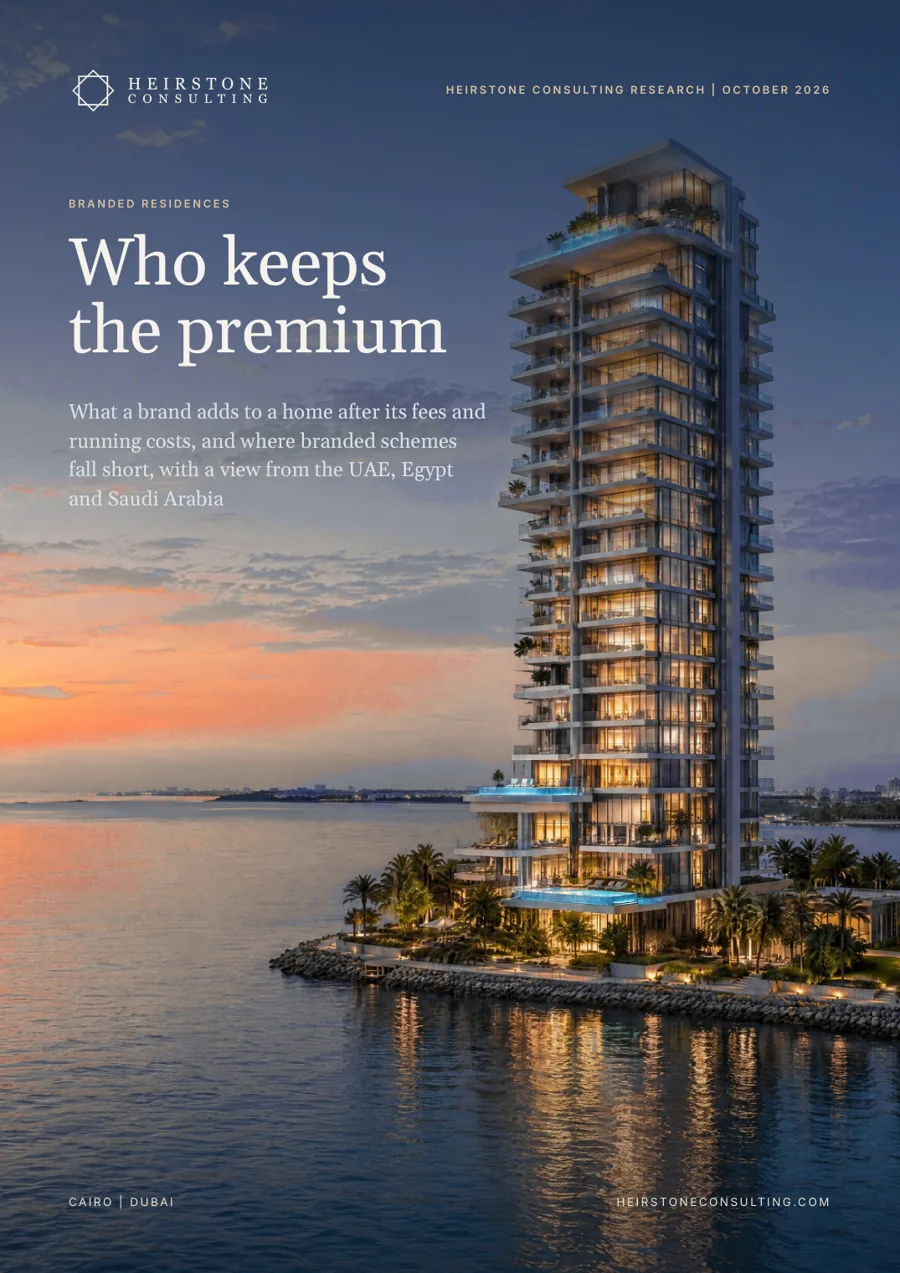
What a brand adds to a home after its fees and running costs, and where branded schemes fall short, with a view from the UAE, Egypt and Saudi Arabia.
The report in six numbers
brand premium on a Dubai home that a 5.5% royalty and a typical service-charge uplift would use up in full (Heirstone analysis)
Dubai branded premium reported for H1 2026 by Morgan's International Realty; Savills' matched estimate was 29% (2020)
gap between Dubai's average off-plan branded price, AED 3,853 per sq ft, and Knight Frank's Prime Index (2025)
branded units added to Dubai's stock in H1 2026, against 4,648 branded homes sold
spread between the cheapest and dearest of ten registered Bugatti Residences trades, August and September 2026
Cairo's branded pipeline against its completed schemes: 26 against 2 (Savills)
In brief
Branded homes do sell for more. For anyone underwriting one, the useful questions are how much of the extra price belongs to the brand, who receives it and whether it is still there when the owner sells. On the public evidence, the brand's share is smaller than the headline numbers suggest, and most of it leaves the scheme at the first sale while the owner pays to keep the name on the building.
Published Dubai premiums run from 88.6% (Knight Frank, 2023) to 56% (Morgan's International Realty, H1 2026), on broad comparisons that include location. Matched to comparable homes, Savills found 29% in 2020, and Morgan's found under 10% in villa communities.
A royalty of 5 to 6% of the sale price takes about a quarter of a 30% premium, and branded towers' service charges run at 1.2 to 3.1 times their neighbours'. On our central case these two costs absorb the whole of a 19.7% premium.
Of a 30% premium, about 24% goes to the brand as a one-time fee and 76% to the developer. The owner nets about 4.4% against 5.3% for an unbranded home, and about 80% of Dubai's branded deals are off-plan first sales.
Ten registered trades at Bugatti Residences in August and September 2026 had a median 38% below the launch record. Armani Beach Residences traded at or just below its launch price two years on, while a Bulgari Lighthouse penthouse sold 37% above its scheme average.
Dubai's branded stock grew 34% in the year to June 2026 while branded sales fell 21%. Cairo has 26 branded schemes in the pipeline against 2 completed, and Ras Al Khaimah 24 against none.
What it means
Publish branded resale data and require the brand's term, termination rights and service-charge budget to be disclosed at sale.
Underwrite a premium of about 30%, the level found against comparable homes, against the 20% bar; keep schemes small and phase homes to hotel delivery.
Value on registered trades and net yield, and price the chance that the name comes off.
Inside the full report
Heirstone datasets
named branded schemes in the Heirstone Branded Residence Register, from Marrakech to Muscat
Dubai schemes in the Heirstone Launch-to-Trade Register
Built from public sources current at October 2026. Every figure is referenced in the report, and figures we derive by combining published numbers are labelled Heirstone analysis.
Yes, but less than headline figures suggest. Broad comparisons put the Dubai premium at 56% to 88.6%; against comparable homes Savills measured 29% in 2020 and Morgan's under 10% in villa communities. Much of the headline gap reflects location rather than the brand.
On Heirstone's central case, about 20%. A 5 to 6% royalty and the higher service charges of branded towers absorb the whole of a 19.7% premium, so schemes should be underwritten against a premium of around 30%.
Mostly the developer and the brand, at signing: of a 30% premium about 24% goes to the brand as a fee and 76% to the developer. The owner earns about 1.5% a year on the extra capital and nets a lower yield than an unbranded home.
Real Estate Strategy
Speak directly with a senior partner about your project, asset or programme.
Get in Touch