Seasonal Coastal Cities: Built for August
Why resort coasts empty out after the summer, what has made a few of them work all year, and what it means for Egypt's North Coast, Ras El Hekma and the Saudi Red Sea.
27 pages · PDF · English · Free
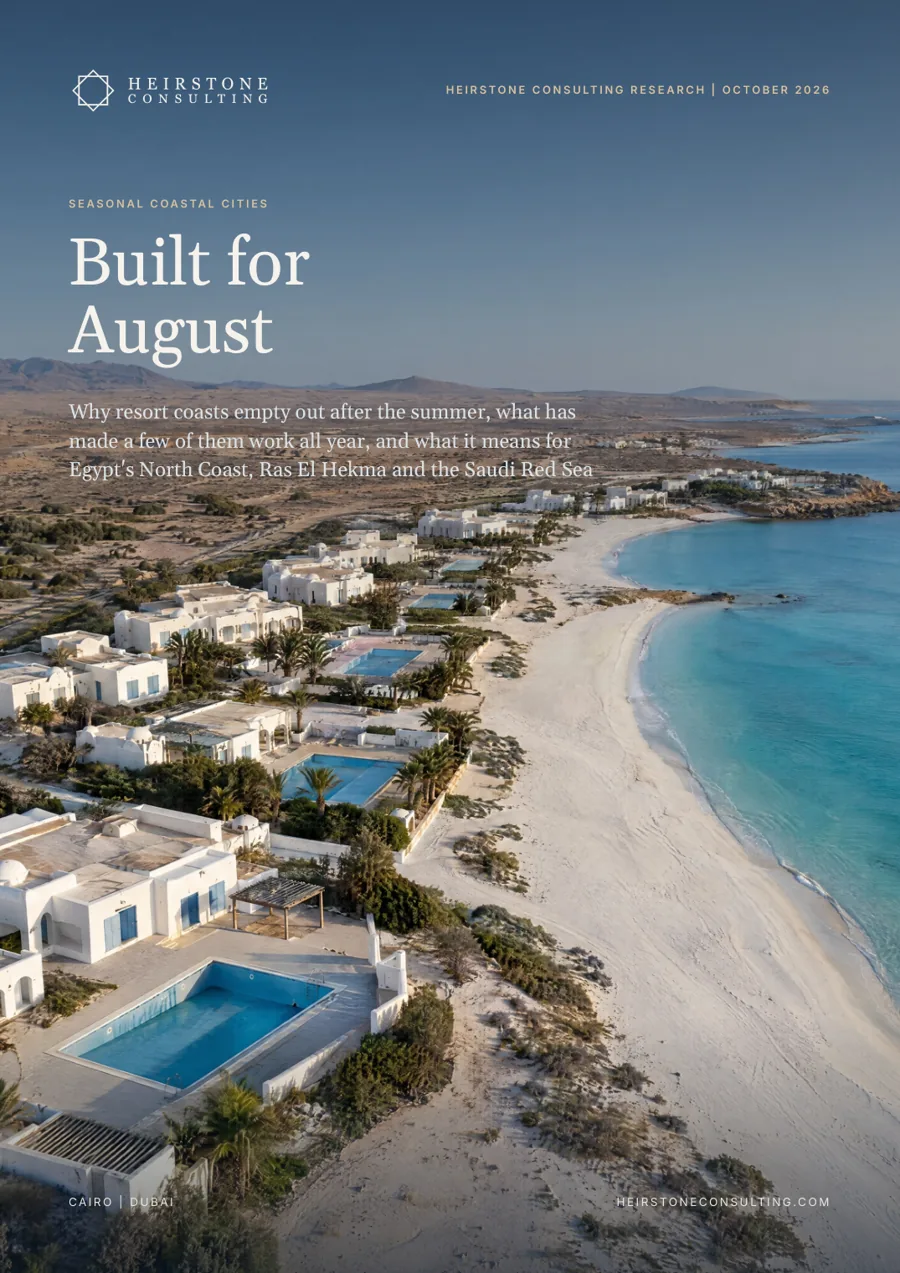
Why resort coasts empty out after the summer, what has made a few of them work all year, and what it means for Egypt's North Coast, Ras El Hekma and the Saudi Red Sea.
The report in six numbers
Crete's tourist nights in August 2025 against January; its main airport swung 14.3 times
dwellings per resident at La Grande-Motte in 2023, a purpose-built French resort; in 1975 the figure was 2.47
of the Algarve's November to March tourist nights in 2024 came from foreign guests
year-round residents of New Alamein in 2025 on an Enterprise estimate, against long-term targets of 1.6 to 3 million
Ras El Hekma's planned population of over one million against Matrouh governorate's 547,700 residents in 2023
a day of North Coast desalination capacity targeted for 2028, 2.6 times the capacity in place in 2026
In brief
We measured seasonality at 20 resort airports and in 12 coastal regions, and the housing of 31 resort towns. The coasts that work all year have two things the others lack: homes that are lived in and a winter market that arrives by air. Most also have a large employer that stays open in February.
Our Seasonality Index divides a year's air passengers by those of the busiest month: Mykonos's year is worth 4.0 peak months and Lanzarote's 10.8. Crete's tourist nights in August 2025 were 78.6 times January's, and its bed-places were 94% used in August and 1.2% in January.
Foreign guests supply 80.9% of the Algarve's November to March nights. Between 2014 and 2024 Faro's winter passengers rose 98.6%, twice the growth of its summer, and Malaga's January traffic rose 128%.
La Grande-Motte had 2.47 dwellings per resident in 1975 and 2.46 in 2023. Of 11 French resorts, only the two inside an urban corridor have a majority of homes lived in all year.
Large universities, state-funded winter travel and a big city within daily reach go with fuller winters. Spain's 27,875 digital-nomad permit holders equal about a ninth of Marbella's estimated summer influx.
Matrouh had Egypt's highest housing vacancy in the 2017 census, 46.9%. Ras El Hekma is planned for over one million people, 1.8 times Matrouh's population, while New Alamein's year-round residents are estimated at 13,000 to 15,000.
What it means
Fix the housing mix, the first institutions and the phasing of utilities in the masterplan, and publish monthly data on airports, hotels and utilities.
Report January occupancy alongside sales and lead each phase with hotels, campuses or clinics that stay open all year.
Underwrite on the November to March share of demand and treat incentive-led and event-led demand as cyclical.
Inside the full report
Heirstone datasets
series in the Heirstone Seasonality Index: 20 airports plus proxies for Egypt and the UAE
resort towns and counties in the Heirstone Resort Permanence Benchmark
checks in the January Test, applied to the North Coast, New Alamein, Ras El Hekma and the Saudi Red Sea
Built from public sources current at October 2026. Every figure is referenced in the report, and figures we derive by combining published numbers are labelled Heirstone analysis.
Because most were built for a domestic summer market: homes are second homes rather than lived in, and winter demand, which comes mainly from abroad by air, was never planned for. Crete's tourist nights in August 2025 were 78.6 times January's.
Homes that are lived in, a winter market that arrives by air and, usually, a large employer such as a university or hospital that stays open in February. The housing mix a resort starts with tends to persist for decades.
They are being built at a scale beyond any resort in the benchmark, on a summer market. Heirstone's January Test sets five checks, from housing mix to winter air access and anchor institutions, for any coastal city plan.
Tourism Development
Speak directly with a senior partner about your project, asset or programme.
Get in Touch