Event Venues and Legacy: Planning for day two
What became of 30 Olympic, Expo and World Cup sites after the crowds left, and what the Gulf and Egypt can settle now for the venues they are building next.
28 pages · PDF · English · Free
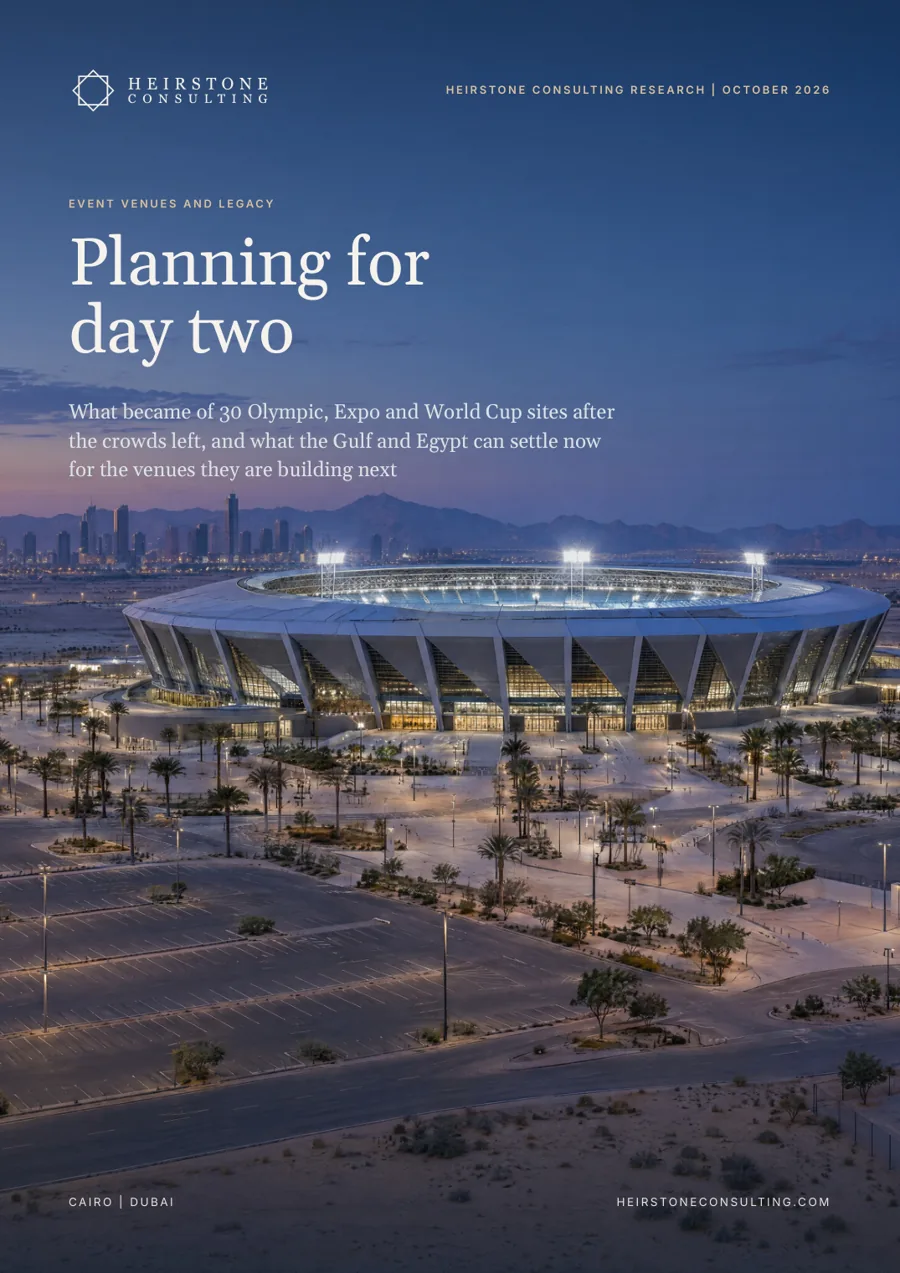
What became of 30 Olympic, Expo and World Cup sites after the crowds left, and what the Gulf and Egypt can settle now for the venues they are building next.
The report in six numbers
average real cost overrun of the Olympic Games from 1960 to 2016; every Games with data overran its budget
of the seats in its seven new World Cup stadiums Qatar planned to remove; Lusail drew 84,517 to the Arab Cup final in December 2025
of the London Aquatics Centre's Games seats kept for everyday use: 2,800 of 17,500
homes in Harumi Flag, Tokyo's former athletes' village, on about 18 hectares
of Expo 2020's buildings and infrastructure kept at Expo City Dubai, which reopened six months after the Expo closed
of a 46,000-seat bowl filled by the Saudi Pro League's 2025-26 average crowd; ten new stadiums are planned for the 2034 World Cup
In brief
We followed 30 Olympic, Expo and World Cup sites from closing ceremony to October 2026. The sites that reopened quickly had their landowner and their buyer or tenant fixed in contracts before the event. Where these were settled afterwards, the main reuse took between three and 22 years, and some sites are still waiting.
Lisbon's Expo site reopened as a city district 15 days after the fair closed, Expo City Dubai after six months and part of London's Olympic Park within a year. Where the anchor or development partner came later, the main reuse took three to 22 years.
London kept 16% of its Aquatics Centre seats by unbolting two temporary wings. Qatar planned to remove 58% of the seats in its seven new stadiums; by December 2025 we found no confirmed removal.
Athletes' villages convert because a flat still has a buyer once the event has gone. Paris is converting its village into 2,807 homes, Tokyo's Harumi Flag holds 5,632, and London sold its village for £825m before the Games.
Sevilla TechPark reports 35,806 jobs on the Expo 92 site, 33 years on. Every Olympic Games with data has overrun its budget, by 156% on average in real terms.
Saudi Arabia's ten new 2034 stadiums add 508,505 seats, against Saudi Pro League average crowds of about 8,000. Egypt already holds about 255,000 seats in its three largest stadiums; its day-two task is to find them tenants and a calendar.
What it means
Write the day-two owner, tenant and seat count into the host agreement, with a published reopening date.
Treat the village and the event estate as the first phase of a district and phase the rest on absorption measured in decades.
Underwrite households and anchor leases, and treat seat revenue as event-day income.
Inside the full report
Heirstone datasets
sites in 17 countries in the Heirstone Day-Two Benchmark: 12 Olympic, 9 Expo and 9 World Cup
tests in the Heirstone day-two readiness scorecard, each tied to a benchmark case
Built from public sources current at October 2026. Every figure is referenced in the report, and figures we derive by combining published numbers are labelled Heirstone analysis.
It depends on contracts signed before the event. Where the landowner and the buyer or tenant were fixed in advance, sites reopened within a year; where they were settled afterwards, the main reuse took three to 22 years.
Housing. Athletes' villages convert because homes still have buyers once the event has gone: Paris is converting its village into 2,807 homes and Tokyo's Harumi Flag holds 5,632.
The day-two owner, tenant and seat count, written into the host agreement with a published reopening date. Saudi Arabia's ten new 2034 stadiums add 508,505 seats against league crowds of about 8,000.
Special Projects
Speak directly with a senior partner about your project, asset or programme.
Get in Touch