Home Real Estate Strategy Tourism Development National Vision Strategy Special Projects Digital Transformation Experience Reports Insights About Us Services Contact
Englishالعربية中文日本語EspañolFrançaisItalianoPortuguêsΕλληνικάDeutschSuomiDanskRomânăKiswahiliРусскийКыргызчаҚазақшаTürkçe

Heirstone Consulting Research · The Africa Series · October 2026

Flexible Workspace: Renting the brand

How flexible-office operators are handing the fit-out and the risk back to building owners, and which structure suits landlords from Cairo and Casablanca to Lagos, Nairobi, Abidjan and the Gulf.

27 pages · PDF · English and French · Free

Also available in French: Espaces de travail flexibles: La marque à louer. Choose the language when you request the report.
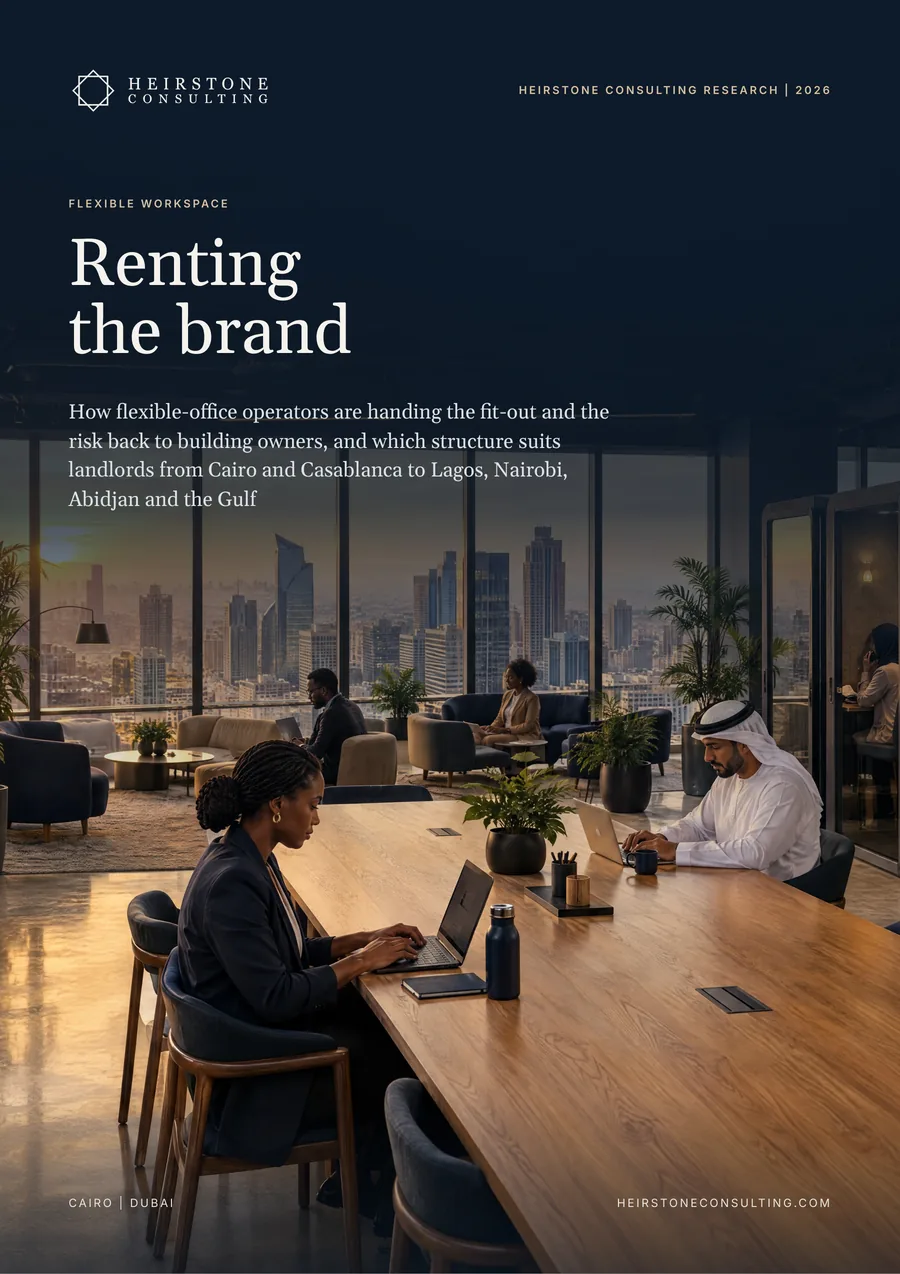

Cover of the Heirstone Consulting Research report Flexible Workspace: Renting the brand

The report in six numbers

98%

of the 728 centres IWG signed in the first half of 2026 were capital-light, funded by building owners or franchise partners

US$1.2m

net growth capital IWG spent per new centre in 2017-19, against about US$72,000 in the 18 months to mid-2025, as owners and franchisees took on the fit-out (Heirstone analysis)

15%

of managed and franchised system revenue kept by IWG as fees in the first half of 2026, of which recurring management fees were 6.5% (Heirstone analysis)

14.6 m²

of prime office in Dar es Salaam rented by one month of IWG's entry price, against 0.8 m² in London: the Heirstone Desk-to-Lease Ratio across 22 cities

186

IWG centres in 18 Sub-Saharan countries, 47% of them in South Africa. Kenya's count rose from 12 to 30 in about fifteen months.

66

locations listed on IWG's Egypt pages in 2026, the most of the nine Middle Eastern and North African countries covered, against 18 Egyptian centres at the end of 2024

In brief

Flex operators have handed the floor back to building owners. In Africa and the Middle East the question is which structure to sign, and on what numbers.

We assembled public evidence on flex operators and landlord brands in Africa, the Middle East and Europe, and benchmarked IWG's entry prices against prime office rents in 22 cities. IWG now signs almost no leases: owners fund the fit-out and rent the brand. Flex prices vary far less than rents, so the spread an owner can keep is widest where rents are low, and most owners in Africa and Egypt should start from a management agreement or a revenue share.

  1. IWG has almost stopped signing leases, and Europe is following.

    IWG signed 728 centres in the first half of 2026, 98% of them capital-light, and its managed and franchised network doubled to 2,230 in eighteen months. In Europe 63% of operators now expand through management agreements, against 45% in 2023, according to Workthere.

  2. Owners now fund the fit-out and pay for the brand with a share of revenue.

    IWG's growth capital fell from about US$1.24m per new centre in 2017-19 to about US$72,000. Its fees take about 15% of managed and franchised revenue. The larger cost to the owner is the ramp: managed centres earned 40-62% of the revenue per room of IWG's own centres.

  3. Flex prices vary far less than rents, so the spread is widest where rents are low.

    Across 22 cities IWG's entry prices vary about sevenfold and prime rents sixteenfold. One month of the entry price rents 14.6 m² of prime office in Dar es Salaam, 7 m² in Nairobi and Dakar and under 1 m² in London and Lagos. Where the ratio is high, a fixed lease hands the spread to the operator.

  4. Sub-Saharan Africa is a partnership market, with landlord capital in South Africa.

    IWG lists 186 centres in 18 Sub-Saharan countries, and its Kenyan count rose from 12 to 30 through partnerships with local owners. Growthpoint, a South African REIT, was reported in 2019 as half-owner of Workshop17 and launched its own flex brand in 2022. KOFISI, AfricaWorks and Norrsken House Kigali add premium, francophone and campus formats.

  5. Egypt sets the pace, and local operators already work with landlords.

    IWG calls Egypt its fastest-growing market in the Middle East and Africa. It had 18 Egyptian centres at the end of 2024, its Egypt pages listed 66 locations in 2026, and it says its largest centre worldwide will open at The Ark in New Cairo. Cairo had more flex operators than Paris on Colliers' 2024 count. MQR has worked for landlords since 2017, and CO-55 runs floors under its clients' names.

  6. Six questions point to the structure, and most owners should start from a management agreement.

    The Heirstone flex structure test points to management agreements in New Cairo, Nairobi and Casablanca, revenue shares priced in naira in Lagos and owner capital in South Africa. A fixed lease suits an owner without capital where operators pay a fair rent. An own brand needs a portfolio, capital and a wide spread.

What it means

Recommendations by audience

Landlords and developers

Price every flex floor three ways before signing: as a lease, as a management agreement and as an own brand. Keep the spread where the Desk-to-Lease Ratio is high, and start an own brand only with a pipeline of several buildings.

Investors and lenders

Underwrite managed flex like a hotel: on the ramp, the fee terms and the owner's capital for the fit-out. Treat a currency gap between rent and desk prices as the first risk in a flex lease.

Governments, investment authorities and free zones

Let licensed flex centres serve as a company's registered office and publish the rule. Publish flex stock each year, and open state floors, such as GAFI's free-zone startup offices, to operators under management agreements.

Operators

Offer owners a menu of structures with published fee bases and ramp targets. In francophone Africa, partner with hotel owners and landlords, and sell corporate teams floors under the occupier's own name.

Inside the full report

27 pages of evidence, benchmarks and tests

  1. The operator steps off the lease
  2. Six ways to run a floor
  3. What the brand costs
  4. Twenty-two cities, one price
  5. Partners south of the Sahara
  6. Egypt sets the pace
  7. Choosing a structure

Heirstone datasets

22

cities in the Heirstone Desk-to-Lease Ratio, in Africa, the Middle East and Europe

6

structures on the Heirstone flex structure ladder, with a six-question test for choosing between them

388

IWG locations in the 27 African and Middle Eastern countries covered (Heirstone count)

Built from public sources current at October 2026. Every figure is referenced in the report, and figures we derive by combining published numbers are labelled Heirstone analysis.

Frequently asked questions

What is a management agreement in flexible workspace?

Under a management agreement the building owner funds the fit-out and carries the risk of empty desks, while the operator runs the centre under its brand for a fee. IWG describes its managed partnerships as 100% landlord-funded. Its fees take about 15% of managed and franchised revenue, of which recurring management fees were 6.5% in the first half of 2026 (Heirstone analysis).

Should a landlord lease to a flex operator or sign a management agreement?

It depends on the spread between flex prices and rent, the owner's capital and its portfolio. Where one month of IWG's entry price rents more than 6.3 m² of prime office, as in Dar es Salaam, Nairobi or Dakar, a fixed lease hands most of the spread to the operator. A lease suits an owner without capital in a city where operators will pay a fair rent.

How big is the flexible office market in Egypt?

IWG listed 66 locations on its Egypt pages in 2026, against 18 centres at the end of 2024, and targets 150 by 2030. Colliers counted 73 flex operators in Cairo at the end of 2024, more than in Paris, with flex at 2.2% of office stock. IWG says Spaces at The Ark in New Cairo, at more than 16,000 m², will be its largest centre worldwide.

Real Estate Strategy

How we can help

Explore the practice

Heirstone Consulting Research

More from The Africa Series

All reports

Discuss Your Mandate

Speak directly with a senior partner about your project, asset or programme.

Get in Touch

Heirstone Consulting Research

Get the full report

Enter your details and we will email you a personal download link. Please use an address you can open: the report is sent only to that inbox.