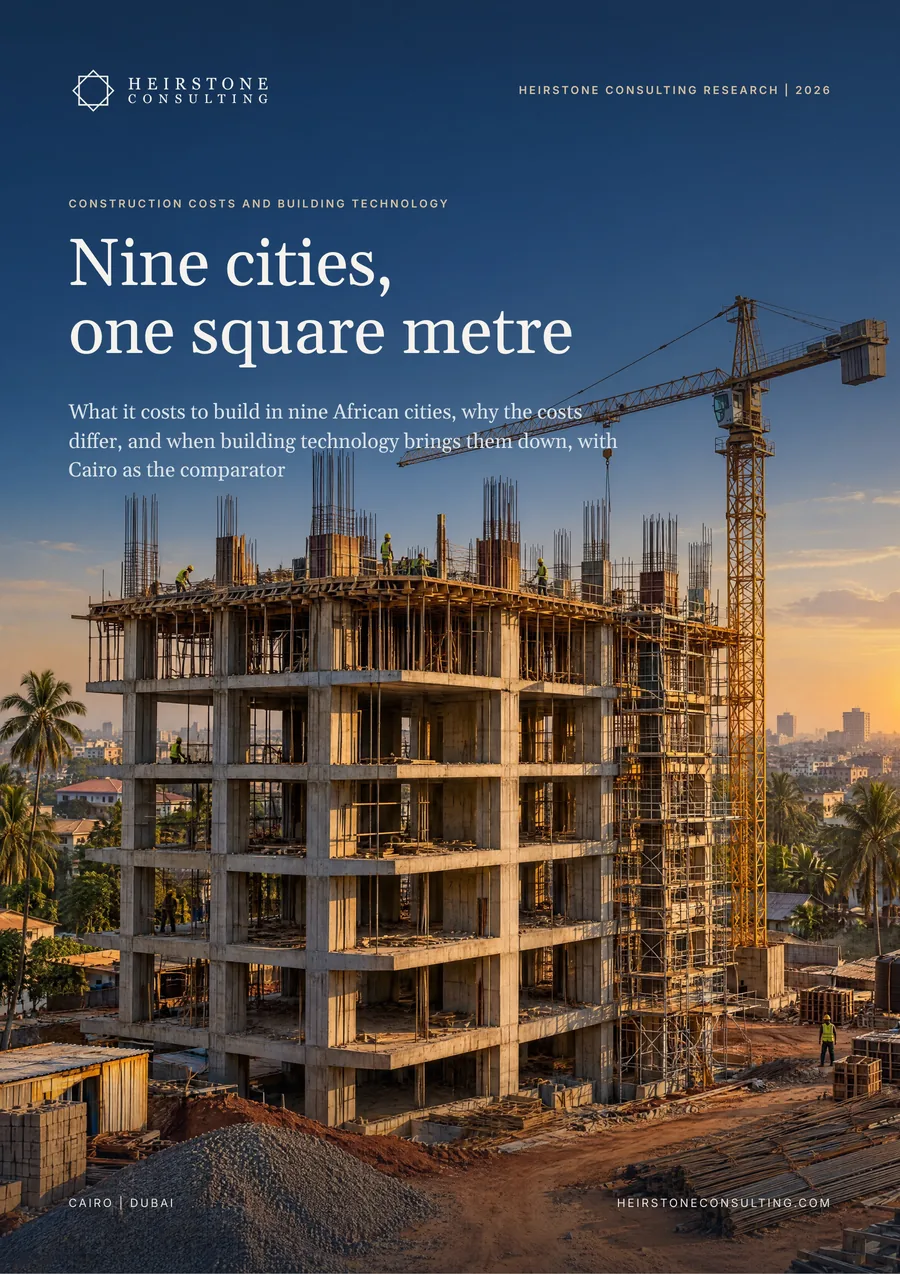
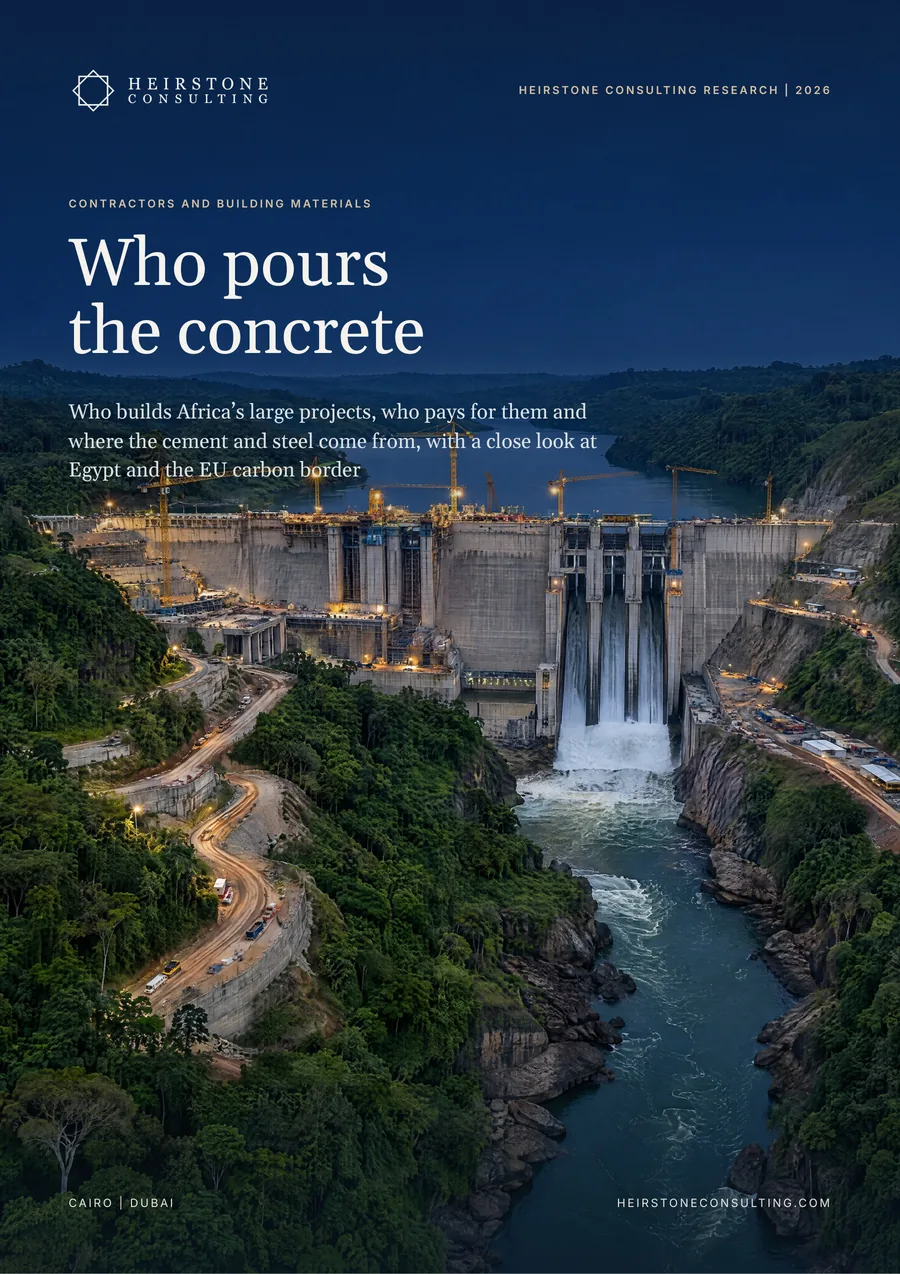
Who builds Africa's large projects, who pays for them and where the cement and steel come from, with a close look at Egypt and the EU carbon border.
Also available in French: Entreprises de construction et matériaux: Qui coule le béton. Choose the language when you request the report.
The report in six numbers
of the African revenue of ENR's Top 250 international contractors went to Chinese firms in 2024: about US$32.5bn of US$52.7bn
fall in Chinese loan commitments to Africa between the 2016 peak and 2024; Chinese contracting revenue in Africa fell about 31% from its own peak
of the large African projects Deloitte tracked in 2021 were built by private domestic firms and consortiums, against 27.1% by Chinese firms
of Elsewedy Electric's EGP 293bn (about US$6.2bn) construction order book lay outside Egypt at the end of 2025
of Côte d'Ivoire's 4.65 Mt of clinker imports came from Egypt in 2024
of the EU's 14.2 Mt of imported cement and clinker came from Türkiye, Egypt, Algeria, Tunisia and Morocco in 2025, the last year before the carbon border charge
In brief
Chinese firms still earn about three of every five dollars that international contractors make in Africa. What has changed is who pays. When one country's lender pays for an African project, a builder from that country usually builds it, as in all eight such projects in our 60-project Ledger. With Chinese state lending down about 93% from its peak, more contracts are paid for by African budgets, development banks and contractor-arranged finance, and are open to builders who bring finance, speed, local presence and materials of their own.
ENR's Top 250 international contractors earned US$48.27bn in Africa in 2020 and about US$52.7bn in 2024. Chinese firms' share of that revenue rose from about 10% in 2002 to about half by 2014 and was 61 to 62% in each year reported since 2019.
Chinese loan commitments to Africa fell about 93% from the 2016 peak to about US$2.1bn in 2024; Chinese contracting revenue fell about 31% from its 2015 peak. In Deloitte's 2021 count, governments funded 31.4% of large projects and China 10.6%, and local firms and consortiums built 43.7%.
In the 60-project Heirstone Africa Builders Ledger, all eight projects financed by a lender tied to one country went to a builder from that country. The seven paid for by development banks, African budgets, a commercial loan or the client went to builders of four nationalities, three of them to Egyptian firms.
Elsewedy Electric holds 72% of its EGP 293bn (US$6.2bn) construction order book outside Egypt, and Petrojet signed 60% of its 2024 contracts abroad. Orascom Construction (US$5.05bn of 2025 revenue, US$9.0bn order book) ranks eighth in Africa in ENR's 2026 ranking. The Egyptian-led Julius Nyerere plant supplies nearly half of the power dispatched to Tanzania's grid.
Egypt's cement and clinker exports rose from US$181.5m in 2020 to US$909.8m in 2024; it supplied 63% of Côte d'Ivoire's clinker imports. In 2025 finished cement rose 42% to US$493m and became the main export line, and rebar sales to Africa reached US$171m, four times the 2023 level.
Five Mediterranean origins supplied 74.6% of EU cement and clinker imports in 2025. At a constant 2026 certificate price, a plant at the EU benchmark pays about €1.25 a tonne of clinker in 2026 and about €24 in 2030.
What it means
Separate the choice of financier from the choice of builder where you can, and compare each tied package with an open tender for the same scope. Use development-bank and budget money to widen the field, publish contract values and financiers, and ask importers of clinker and rebar for verified plant emissions now.
Look behind the prime contractor: list who builds each part and whose equipment is installed. Price the schedule where the date has value, contract cement and steel from at least two origins, and benchmark unit prices: US$4m to US$6m per kilometre for most standard-gauge sections in the Ledger.
Treat contractor-arranged finance as a growth market: guarantee lines like Afreximbank's US$3bn of 2023 facilities let mid-sized firms bid for large African contracts. Fund grinding plants, bulk terminals and storage on the West African coast, and put the carbon border's back-loaded cost into the credit models of Mediterranean cement and steel exporters.
Sell the route as well as the price, and pair contracts with finance and with Egyptian cement and steel. Carry repeat-client franchises into francophone markets, verify plant-level emissions, keep moving from clinker to finished cement and market electric-route steel as low-carbon rebar.
Inside the full report
Heirstone datasets
projects in 24 countries in the Heirstone Africa Builders Ledger, with value, builder, financier and route to the contract
routes to a contract in the Heirstone Five Routes: finance, presence, partnership, speed and price
tied-credit projects in the Ledger built by a firm from the lender's country
Built from public sources current at October 2026. Every figure is referenced in the report, and figures we derive by combining published numbers are labelled Heirstone analysis.
Chinese firms earned 61.6% of the African revenue of ENR's Top 250 international contractors in 2024, about US$32.5bn of US$52.7bn, and their share has been 61 to 62% in each year reported since 2019. Across all large projects, Deloitte found in 2021 that private domestic firms and consortiums built 43.7% and Chinese firms 27.1%.
Five Egyptian firms were on ENR's 2024 Top 250 International Contractors, as many as France or India. Orascom Construction ranks eighth in Africa in ENR's 2026 ranking, Elsewedy Electric holds 72% of its EGP 293bn construction order book outside Egypt, and Petrojet signed 60% of its 2024 contracts abroad. Arab Contractors and Elsewedy built the Julius Nyerere hydropower plant in Tanzania.
Since the start of 2026 EU importers of cement and steel owe a carbon charge, and certificates go on sale in 2027 for 2026 imports. At a constant 2026 certificate price, a plant at the EU benchmark pays about €1.25 a tonne of clinker in 2026 and about €24 in 2030. Türkiye, Egypt, Algeria, Tunisia and Morocco supplied 74.6% of the EU's imported cement and clinker in 2025, so the charge could send more Mediterranean supply towards Africa.
Special Projects
Heirstone Consulting Research
Speak directly with a senior partner about your project, asset or programme.
Get in Touch